

This post is the first of a series of short articles that I am currently working on. The objective really is to rediscover the small grid connected renewable energy projects commissioned across the Caribbean. (more…)
Category: Wind Energy
-
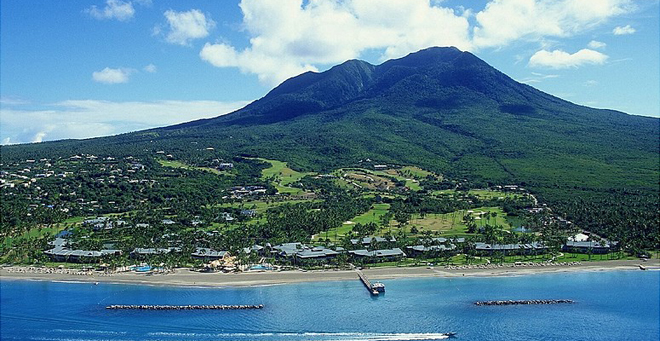
Greening Nevis Electricity Sector
Nevis, the sister isle of St. Kitts, is on its way to becoming carbon neutral in the near future. The two-island state is part of the Leeward Islands chain in the Eastern Caribbean. The small island of Nevis is home to a population of about 12,000 and it receives approximately 90 percent of its energy from imported oil products, with the remaining share coming from wind power. Nevis has its own electric utility, Nevis Electricity Company Limited (Nevlec), which owns and operates capacity of 13.4 MW with peak demand of around 9 MW and a base load of 5 MW.
 In 2010, Windwatt Nevis Ltd. (a private developer) installed a 2.2 MW wind park at Maddens Estate. The Maddens Wind Park, which consist of 8 Vergnet 275 kW wind turbines, supplies energy into Nevlec’s 11kV distribution grid. Nevlec is obligated to purchase up to 1.6 MW of energy from the wind park according to the Power Purchase Agreement (PPA) between the two companies.
With wind power experience under its wings, Nevis is now pushing to exploit its vast geothermal energy potential. The Nevis Investment Agency (NIA) is currently welcoming proposals from potential developers with strong financial backing for the development of geothermal. The exploration phase has been completed and it is anticipated that least a 10 MW geothermal plant can be constructed in the not too distant future.
 If, or when, this is achieved Nevis will be uniquely placed within the sub-region as a low cost, stable and renewable energy supplier. This project would have many positive benefits for the island including reduction in the cost of electricity; increase employment; energy security; improvement in the investment climate; significant revenue generation from royalty payments, electricity sales domestically including to St. Kitts and potentially neighboring islands. The project would have strong linkages to other sectors such as tourism and agriculture for heating purposes.
 -

The Economics of Wind Power in Jamaica
In late 2013, the Office of Utilities Regulation (OUR) named three preferred bidders for the supply of up to 115 MW (megawatts) of electricity generation capacity from renewable energy. The three preferred bids amounted to a total 78 MW of energy only renewable energy capacity, including two projects offering energy from wind amounting to 58 MW, and one offering solar amounting to 20 MW. The proposed delivery price to the grid ranged from US$0.1290 to US$0.1880.
The preferred bidders were:
1. Blue Mountain Renewables LLC, to supply 34 MW of capacity from wind power at Munro, St. Elizabeth;
2. Wigton Windfarm Limited, to supply 24 MW of capacity from wind power at Rose Hill, Manchester; and
3. WRB Enterprises Inc., to supply 20 MW of capacity from Solar PV from facilities in Content Village, Clarendon.
The 20 MW solar farm will be the first of its kind in the Island, however Jamaica’s first grid-connected wind-powered generator was commissioned in February 1996 at Munro College. This wind turbine-generator, a Vestas V27 – 225 kW, was also the first grid-connected wind-energy source in the English-speaking Caribbean. The project was funded primarily by the Environmental Foundation of Jamaica (EFJ), but also included a long list of local companies and individuals. The total installation cost of the facility was US$300,000. However, much of the local services, such as JPSCo’s services and Alpart’s crane services, were donated free of cost.
The overwhelming success of the the Munro College wind turbine encouraged the Petroleum Corporation and the Government of Jamaica to commission Jamaica’s first large scale wind farm at Wigton (in the parish of Manchester) in 2004. The initial 20.7 MW wind farm, which came to be known as Wigton I, comprises of twenty three (23) NEG Micon NM52 – 900 kW wind turbines. The project was financed at a total cost of US$26.2 million with equity injection of US$ 3.2 million from the Petroleum Corporation of Jamaica (PCJ), a US$ 16 million loan from the National Commercial Bank of Jamaica (NCB) and a grant of US$ 7.0 million from the Netherlands Government.
A midst several changes, including $150 million in lost revenues due to unfavorable energy rates and $120 million due to penalties imposed by JPS for reactive power demand and a fail divestment attempt in early 2007, the Wigton wind farm was expanded during the period 2009 to 2010 to include nine (9) Vestas V80 -2.0 MW wind turbines. The 18 MW project, now called Wigton II, was financed from the PetroCaribe Development Fund at total cost of US$49.9 million.
In late 2010, JPS (the owner and operator) commissioned its first wind project – a 3 MW wind farm at Munro, St. Elizabeth. This project comprises of four (4) UNISON U50 – 750 kW wind turbines and was completed at a total cost of US$9.3 million. The Munro wind farm interconnects to JPS 24kV distribution system unlike the Wigton wind farms, which interconnects to JPS 69kV system via a 11km long tie-line. It is worthwhile noting that the grid interconnection cost can account for as much as 8-9% of the total project cost. In the case of the Wigton wind farms the 11kM 69kV line was included in the capital cost of the initial project.
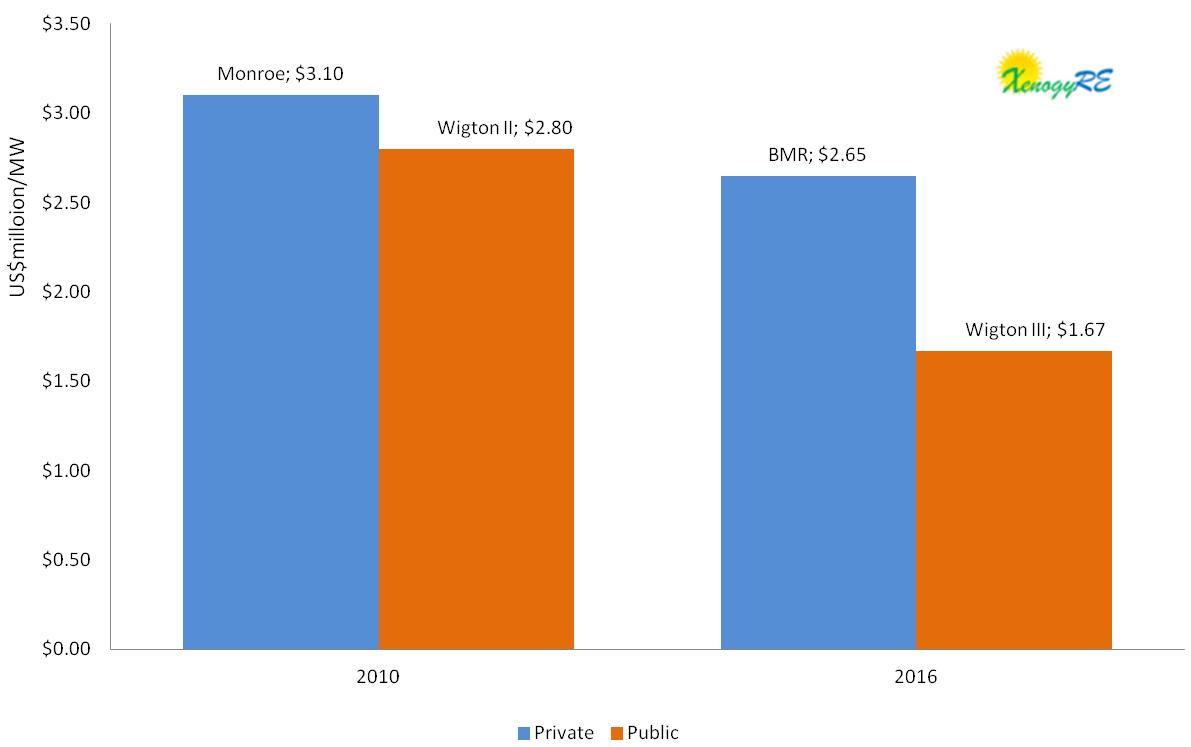
The two new wind farms coming out of the OUR latest request for renewable energy in addition to the national grid are projected to cost US$40 million for the WWF’s (Wigton Windfarm) 24 MW wind farm and US$90 million for the BMR’s (Blue Mountain Renewables) 34 MW wind farm. The cost of these two project forces me to ask one key question “how does public vs private investor wind power projects costs compare?”. I thought that a good way to get a fair comparison was to look at the projects that had/have the same/similar time horizon. So, I decided to firstly compare the Wigton II and JPS Munro wind farm projects (which were both commissioned in 2010) and secondly the proposed Wigton III and BMR Munro wind farm projects (both scheduled to be commission in 2016), as shown below.

This comparison revealed two important facts:
1. Private investor wind projects in Jamaica cost more than public wind projects. In the first case, the JPS Munro wind farm cost approximately 1.1 times the cost of the Wigton II wind farm on a per megawatt basis. Similarly, the proposed BMR Munro wind farm will cost approximately 1.6 times the proposed Wigton III wind farm on a per megawatt basis. It would be good to see a breakdown of the project cost to see exactly where the projects varied in term of cost.
2. The cost of wind power has come down by 40% for public projects and 15% for private projects since 2009.
 The cost of a wind project has a lot to do with its total size (economics of scale) however the most common way to compare wind project cost is on a per megawatt basis, as was done here. It is also worthwhile to add that the basic cost components of wind projects typically include: turbine cost, grid interconnection, foundation, electrical installation, consultancy, financial cost, road construction, control systems, etc. The inserted table gives a break down of the % share of the total cost for each component.
Public projects, in most cases, could have a competitive advantage in terms of the land rental, financial cost and road construction components which could possibly explain to some extent why public projects have been carrying lower project cost compared to the few private projects that we have seen in Jamaica’s recent renewable energy history.
-

Wind Power Basics
Wind is simply air in motion. It is caused by the uneven heating of the Earth’s surface by the sun’s radiant energy. This motion is due to difference in the earth’s surface composition, which causes a (more…)
-

ABC Islands Wind Farms
The islands of Aruba, Bonaire and Curaçao forms a chain of islands in the Caribbean known as the Leeward Antilles. Together these islands has an installed wind capacity of approximately 71 MW. These (more…)
-

Largest Onshore Wind Farms in the World
The following is a list of the five larges wind farms in the world:
1. The Alta Wind Energy Center is a wind farm located in (more…)
-
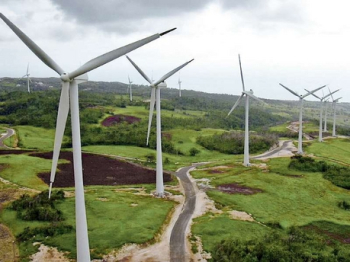
Wigton makes move to increase its Capacity by 62%
Wigton Windfarm Limited’s (WWFL) plans to start expansion of its 38.7 megawatts (MW) wind farm by an additional 24 MW this year . Wigton phase III, which will be located in Rose Hill, Manchester on lands adjoining the (more…)
-

Cuba gone with the Winds
Cuba, the largest of the beautiful islands of the Caribbean – often referred to as the “Pearl of the Antilles”, recently unveiled plans to embark on a massive wind power development project. The project will see the integration (more…)
-
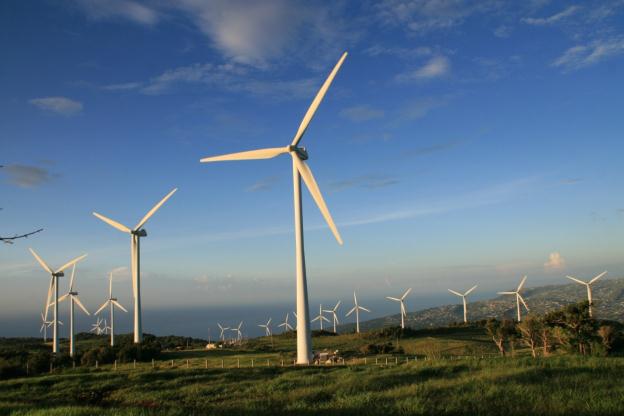
Jamaica Leads with 41.93 (MW)
Jamaica currently leads the Caribbean in wind energy integration, boasting an installed capacity of 41.93MW (Megawatts). Its latest addition to the national grid being the Munro Find Farm, completed in September 2010. (more…)
-
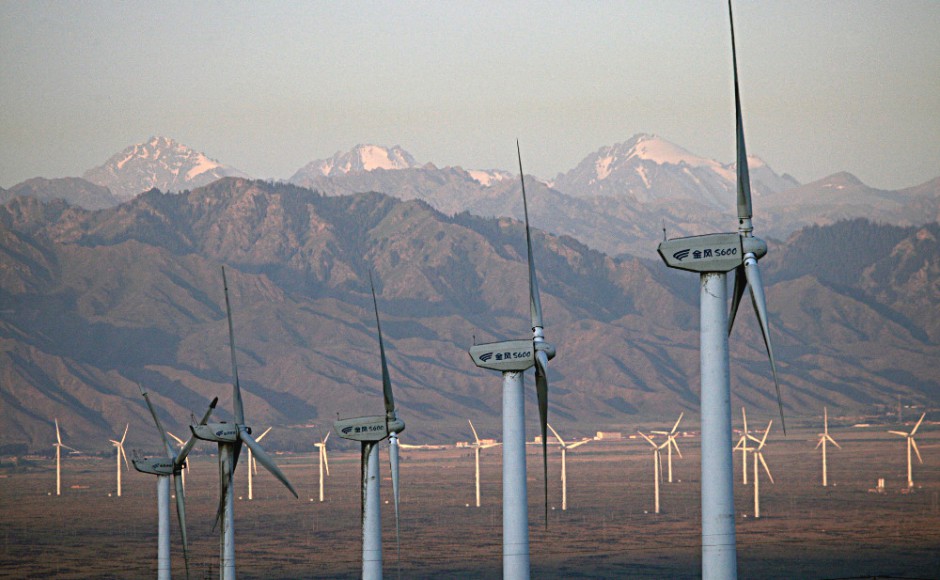
China Leads Growth in Global Wind Power Capacity
Global installed wind power capacity continued to grow in 2011, according to new research conducted by Worldwatch Institute Vital Signs Online service. The data collected showed that global wind power capacity topped out at 238,000 megawatts (MW) after adding just over 41,000 MW. This means that the global capacity grew by 21 percent in 2011, albeit lower than the 2010 rate of 24 percent and markedly lower than the 2009 rate of 31 percent. Nonetheless, the world now has four times as much installed wind power capacity than in 2005 (just seven years ago) reflecting the combined effects of falling prices, improved technology, global investment, and various incentive programs. China led the way with a 43 percent share of global capacity additions in 2011, followed by the United States at 17 percent, India with almost 7 percent, and Germany at 5 percent, writes report author and Climate and Energy Program Manager Mark Konold.
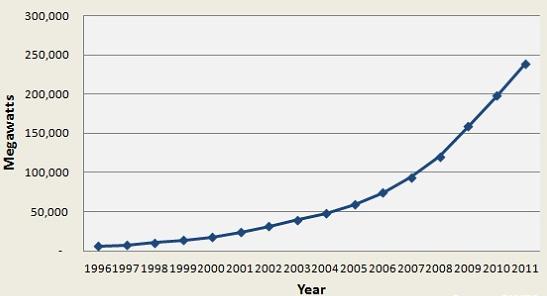
Total World Wind Energy Capacity, 1996-2011 In terms of cumulative capacity, China has a commanding 26 percent of global installed capacity. A total of almost $75 billion was invested in wind energy installations in 2011, which was 22 percent less than invested in 2010. For the second year in a row China set the pace and propped up the industry, increasing its total capacity by 40 percent over 2010 levels. China added just over 17,000 MW of new capacity, bringing its grand total to close to 63,000 MW. There remains an important gap between total installed capacity and actual electricity available for use from wind power, however. Despite having the most installed wind capacity, China still struggles to use all the electricity its turbines generate. read more at www.worldwatch.org
 xenogyre.com