Category: Renewable Energy

  • Market Acceptance Challenges for Alternative Energy Projects in T&T

    Market Acceptance Challenges for Alternative Energy Projects in T&T

    Alternative energy is high on the policy agenda in countries around the world and most governments have set ambitious targets and have implemented support schemes aimed at facilitating market acceptance. The same is true here in the Twin Island Republic of Trinidad & Tobago, with the Government’s announcement in its 2016 fiscal budget of its intention to achieve 10% renewable energy (RE) penetration by 2021.

    This equates to an extremely ambitious endeavour to realize of over 200 megawatts (MW) of RE in under five years, in light of the absence of the necessary amendments to the Trinidad & Tobago Electricity Commission (T&TEC) Act, Chapter 54:70 and Regulated Industries Commission (RIC) Act, Chapter 54:73 to allow for open access to the national grid and with the present installed generation capacity at 1,994MW, peak system demand of 1,396MW and a 2021 forecasted peak demand of 2,044MW, would equate to an extremely challenging endeavour to realize of over 200MW of RE by 2021.

    In spite of this, as a T&TEC Engineer, I still feel encouraged as at the end of 2016 that there were still some micro-scale RE projects already commissioned throughout T&T. Some of these include:

    • Hybrid Renewable Energy – 2.5kW Wind & 2.0kW Solar PV Power Projects at Islamic Home for Children, Gasparillo.
    • 2.2kW Solar PV at T&TEC, Mt. Hope.
    • 2.2kW Solar PV at UTT. O’Meara
    • Community Centre Solar PV Lighting RE Project at nine locations throughout T&T inclusive of North Manzanilla Eastern Main Road, Manzanilla and at Roystonia Caryota Drive, Couva North.
    • UTT Solar House at the UTT Pt. Lisas Energy Campus.
    • T&TEC Solar Powered Street Lights pilot project in Manzanilla.

    In addition to this part of GORTT’s future RE Road Map includes the establishment of:

    • 5MW Solar PV Park at Piarco International Airport.
    • 1MW Waste to Energy (WtE) Plant at Beetham.
    • 10MW Wind Farm at Minister’s Bay, Tobago.
    • A 30MW distributed Solar PV Roof Top Residential Project at HDC Sites throughout T&T.

    In T&T, the price of electricity for residential customers averages around US$0.06/kWh while the equivalent for the rest of the Caribbean is approximately US$0.34/kWh. This fact brings with it unique challenges to market acceptance of RE to T&T. Some of these marketing challenges include:

    • Lack of consumer awareness and understanding of RE projects leads to skepticism by the potential customers.
    • Existing small market size limits the type of market strategy that could be applied.
    • Past market failure in other Caribbean territories have lead T&T investors to be risk averse towards the T&T RE market.
    • Existing fossil fuel energy based “subsides” make RE unattractive due to its longer pay-back period as compared to other Caribbean countries.
    • Perceived “Oil Patrimony” by T&T citizens has resulted in citizens believing that they have the right to cheap energy regardless of the associated environmental issues.

    Some of these barriers to entry to the T&T RE Market can be removed by:

    • Amending of the T&TEC Act and RIC Act to support renewable electricity grid integration.
    • Establishment of an incentivized Feed In Tariff (FIT) by the RIC.
    • Creation of an attractive Policy and Regulatory Frameworks by GORTT.
    • Easy access to financing (via grants for example).

    These overarching issues can be addressed by partnering with RE Market Leaders with internationally accepted manufacturing, distribution and installation supply chains with the roll out of communications, advertising and public relation campaigns to create RE project awareness and brand loyalty. In the end the future of marketing RE must focus Otto Scharmer and Katrin Kaufer theorem of “Ego to Eco” where the ultimate aim is to market RE so that society evolves from one of natural self-interest to one of shared interest of the eco-system.


  • Jamaica’s First Utility-Scale Solar PV Farm

    Jamaica’s First Utility-Scale Solar PV Farm

    In 2013, WBR Enterprises Inc. was selected by the Office of Utilities Regulation (OUR) via a competitive bidding process to develop a 20 Megawatts (MW) solar farm – the island’s first utility-scale solar project. The project was the third lowest bid received, in response to the OUR’s request to supply 115 MW of renewable generation, with a proposed price of US$0.1880 per kilowatt-hour (kWh) to deliver renewable energy to the national grid.

    dsc_0960-300x1241 On September 18, 2014, WBR subsidiary, Content Solar Ltd., signed a 20-year power purchase agreement (PPA) with the Jamaica Public Service Company (JPS) to sell the full output of its solar farm to the grid.

    The 154 acres solar farm, coined Solar Content, subsequently broke ground in Content Village, York Town, Clarendon on July 9, 2015. The $63 million (US) project was financed in part by a $47 million debt agreement with the Overseas Private Investment Corporation (OPIC) and the U.S. Government’s Development Finance Institution for the development. Sponsor equity was provided by WRB Serra, a strategic partner of WRB Enterprises and WRB Energy focused on sustainable infrastructure investments in the Caribbean and Latin America.  The Content Solar plant is the second OPIC-financed project in support of the U.S. Caribbean Energy Security Initiative.image0031

    It is worthy of noting here that, the Content Solar plant is the second OPIC-financed project in support of the U.S. Caribbean Energy Security Initiative. The first being the blue mountain renewable (BMR) 36MW Wind Farm also located in Jamaica.

    And in a historic move on August 28, 2016, the Content Solar farm was launched into commercial operations as Jamaica’s first utility-scale solar PV plant.  The plant which boasts 97,000 solar panels will power more than 20,000 households over the next 20 years under the PPA with JPS.

    According to the Jamaica’s National Energy Policy 2009-2030, the country is looking to significantly increase investments in renewable energy technologies. The country has targeted at least 20% contribution towards the energy mix from renewable energy sources by 2030. The content solar farm pushes Jamaica’s installed renewable capacity to approximately 152 MW or 14.8%.

    Jamaica second utility-scale solar project, the Eight Rivers 33 MW solar farm, is currently ongoing and is estimated to be put into commercial operation by the end of 2018. The commissioning of Eight Rivers project will see jamaica’s renewable energy mix at 17.5%. The planned 190 MW LNG power plant in Old Harbour Bay, St Catherine, which is expected to be completed in early 2019, will change this mix.

    These are certainly exciting times in Jamaica’s electricity market environment as they seek to lower the cost of electric energy in a bid to improve the country’s socio-economic conditions.

  • Marketing Renewable Energy Consultancy in Trinidad & Tobago

    Marketing Renewable Energy Consultancy in Trinidad & Tobago

    Renewable Energy (RE) is once again at the forefront both locally and internationally with the recent display of two opposing views, one by the Prime Minster of Trinidad & Tobago (T&T) versus another by the President of the United States of America (USA).

    The T&T Prime Minister, following his return from RE and Energy Efficiency (EE) conscious Chile, reaffirms his country’s commitment to the tenants of the 2015 Paris Climate Agreement, with specific objectives to be achieved via the reduction of the utilization of fossil fuels and the promotion of RE and EE. The American President, on the other hand, following his return from the recently concluded 2017 NATO summit in Belgium,  unexpectedly announced his country’s withdrawal from the same agreement.

    With these political decisions fresh in our minds, it is worth noting that the success of any RE & EE related product or service introduced into a market is not only based on the political environment but also on the effectiveness of the marketing plan designed for its promotion.

    The T&T RE Market in the past has been virtually non-existent with the present grid-connected RE sources accounting for less than 1% of all grid-connected generation. However, the prospects of the future RE market appear to be more favourable with the Government’s target of 10% Penetration of RE of the total forecasted Electricity Grid Capacity by 2021, specifically from Wind, Solar and Waste to Energy (WtE) technologies. It is expected that the Government will continue to take the lead in the local RE Market, with the implementation of fiscal incentives and amends the relevant legislations to allow for grid connection.

    It is expected that the Government will continue to take the lead in the local RE Market, with the implementation of fiscal incentives and amendments to the relevant legislations for grid connection. However, there will still be room for the introduction of private sector investment in distributed renewable generation sources (DRGS), such as domestic Solar Photovoltaic and Wind Turbine generators as a further means to increase T&T’s energy security and reduce our reliance on fossil fuels.

    Although there is now a more optimistic outlook of the T&T RE Market, further considerations must be made to the fact that (i) the market is still in its Infant Stage and (ii) the cost of fossil based energy in T&T is relatively cheap at less than US$0.06/kWh for Residential Customers and even cheaper energy charges for Industrial Customers with an additional Demand (kVA) Charge. These low rates would result in DRGS having payback periods in excess of 9 years, which renders them less attractive. Thus, a more paternalistic approach to managing the introduction of DRGSs to T&T via the provision of consultancy as a service to all segments of the market for more optimally engineered solutions is required. This RE Consultancy Service must be marketed as a convenience to the customer where it is the consultant who would determine the optimal engineering design and specification solution to the DRGS application that is desired by the customer.

    The effective marketing of RE Consultancy Services as a convenience for the customer is one of the pillars of roll out of DRGSs in T&T as it is essential for the removal of some of the existing barriers to entry the T&T RE Market. Even with the existing barriers to entry to the RE Consultancy Service T&T Market there are still a few RE Product Distributors that act as RE Consultants such as Smart Energy Ltd. and Solar Power Concepts Ltd. Thus the existing competitive landscape for RE Consultant Services is weak as there are just a few players who predominantly focus on Solar Technologies only. While the positioning of RE Consultancy Services should be one where the customer views engaging with a consultant before the initiating of any type RE Project solution being essential to its success.

    In that same vein, the success of the RE Consultancy Service Company is based on the marketing plan effectively defining the market segments. Failure to effectively segment the T&T RE Market for opportunities would result in:

    • Marketing to customers who are less willing to pay the premium for RE Consultancy;
    • Providing only a limited range of initiatives to appeal to customers; and
    • Using unfocused marketing techniques

    In addition to the typical criteria used to segment the market such as demographic, geographic, physiographic and product benefit criteria, the criteria should initially start with the RE type desired by the customer, followed by the maximum aggregate capacity of the DGRS into segments similar to the existing T&TEC Tariff Structure, for example:

    • Up to 5kW, for single phase, 3-wire, 115/230volt DGRS installations serviced under the Domestic and General Tariff (Rate A),
    • Up to 50kW, for single and three phase, 4-wire, 115/230volt DGRS installations serviced under the Commercial Tariff (Rate B),
    • 50kW to 200kW, for three phase, 4-wire 115/230volt DGRS installations serviced under the Industrial Tariff (Rate D1), and
    • Single DRGS with output greater than 200kW shall be installed for self-generation as stand-alone equipment which does not export to the Grid.

    In the end, the effective marketing of RE Consultancy Services according to the specific market segments would help to mold the perception and attitude towards DGRSs and assist achieving nationwide adoption of RE.


  • Island Energy Snapshots – the Caribbean

    Island Energy Snapshots – the Caribbean

    The Islands of the Caribbean are known to have some of the highest electricity rates in the world, with the exception of only a few. This is primarily because more than 95 percent of their energy consumption is derived from imported petroleum products.

    The U.S. Department of Energy and its partners, through the Energy Transition Initiative (ETI), has been working with government entities and other stakeholders to establish a long-term energy vision and successfully implement energy efficiency and renewable energy solutions. ETI provides a proven framework and technical resources and tools to help islands, states, and cities transition to a clean energy economy and achieve their clean energy goals.

    The Island Energy Snapshots is one of several outputs of the ETI. It highlights the energy landscape of islands in the Caribbean, the Pacific, and the surrounding areas. I have taken the liberty of presenting below links to the Energy Snapshots of the Islands in the Caribbean. In these four page documents are relevant and up to date information about the islands’ electricity sector, energy policies, and opportunities to reduce dependence on imported fossil fuels through energy efficiency and the use of renewable energy sources.

    For the Energy Snapshots of the Pacific Islands click here

  • Jamaica Surpasses 100 MW of Wind Power

    Jamaica Surpasses 100 MW of Wind Power

    Recently, two new wind farms (Wigton III and BMR) were commissioned onto the Jamaican electricity grid with a combined capacity of 60 megawatts (MW). This pushes the paradise Island beyond the 100 MW mark, now having total installed capacity of 102 MW.

    The Wigton III Wind Farmcarosel-3Wigton III is a 24 MW wind farm owned and operated by Wigton Windfarm Ltd (WWFL) – a wholly owned subsidiary of the Petroleum Corporation of Jamaica (PCJ). WWFL also own and operate two other farms – Wigton I and II rated at 20.7 and 18 MW respectively. The new facility consists of twelve G80-2.0 MW wind turbines, a 9.6 km 69 kilovolts (kV) transmission line, and a new substation constructed by the Spanish firm Gamesa.

    It is expected to reduce the national oil consumption by an additional 37,100 barrels per year, which can save the country more than JA$230 million annually, adding to the more than JA$3 billion saved by the country in the past 11 years through the operations of Wigton I and Wigton II, commissioned in 2004 and 2010, respectively. The expansion has brought Wigton’s total capacity to 62.7 MW, retaining its position as the largest wind energy facility in Jamaica and the English-speaking Caribbean.

    The BMR Wind Farm

    The BMR (Blue Mountain Renewables) is also a new wind farm, rated at 36.3 MW. It consists of eleven V112-3.3 MW wind turbines, a 18 km 69 kV transmission line and a substation constructed by dutch firm Vestas. The US$90 million project is the single largest private sector investment in renewable energy undertake to date in the Island. BMR will sell electric energy to the grid operator (JPS) at US12.9 cents per kilowatt-hour in accordance with their 20 years power purchase agreement.

    Bottom Line

    These two wind farm projects were selected as the lowest-price projects among 28 proposals offered in response to the OUR’s Request for Proposals (RFP) for the addition of 115 MW of renewable energy power generation capacity in 2012. Given that Jamaica has now gained a decent track record of successfully commissioning wind projects, then it is expected that at least two such wind farms should come online by the end of 2018.

    This is especially, in light of the recent announcement by the Minister of Science, Energy and Technology, Dr. the Hon. Andrew Wheatley, during the 2016/17 Sectoral Debate that the Government will soon be advertising an RFP for the supply of an additional 100 MW of renewable energy.

  • OUR’s Response to Xenogy on 37 MW Project Selection

    OUR’s Response to Xenogy on 37 MW Project Selection

    May 25, 2016

    Mr. Courtney Powell
    Founder & Chief in Editor
    XenogyRE
    Renewable Energy Blog

    Please see O.U.R.’s responses to your correspondence requesting clarification:

    1. On the 27th of January 2016 the OUR reported to have received a total of 17 bids in a media release titled: “OUR GETS 17 RENEWABLE ENERGY BIDS”. However, in the final media release on 9th May 2016 the OUR contradicts this by stating that it had received a total of 19 bits.

    ANSWER: There were 10 entities that submitted bids in response to the OUR’s request for proposals (RFP). One of the bidders submitted two base bids. Mention was made in the proposal letter for each of these bids that they were accompanied by a set of alternative bids. While a notation was made on the bid opening form of the number of alternative bids that were as said to have accompanied one of the base bids (i.e. three alternatives), a similar notation was not included for the other (i.e. two alternatives). The specifics of the alternative bids were not announced and recorded as these details were embedded within the proposal documentation of their relative base bids. During the detailed examination of the bid packages by the evaluation team, the details of all alternative bids were located (including the two alternatives which were not noted on the bid opening form), recorded and subjected to evaluation in accordance with the RFP. This accounted for the difference in number of bids mentioned in the first press release, which was issued immediately after the public bid opening, and the subsequent press release which was issued at the end of the bid evaluation process.

    2. We also noted from the media release on the 27th January 2016 that Eight RiversEnergy Company Ltd submitted two (2) bids for solar PV (one for a 37MW and an alternative for 21MW). However, we also noted that the 33.1 MW Solar PV project they are selected to provide was not listed as one of the bids received in the media release on the 27th of January 2016.

    ANSWER: Although Eight Rivers Energy Company Ltd submitted a bid for a 37MW plant, upon evaluation it was clarified that the plant capacity at the required power factor, was in fact 33.1 MW. It was this project proposal that was ranked highest based on the criteria set out in the RFP.

    3. What prevented the OUR from achieving the intended 37 MW of renewable energy capacity, given that over 300 MW of primary project proposals were reportedly received. And why no mention was made of how the OUR plans to achieve the remaining 4.9 MW. This is of concern because it is a large short fall – by comparison this size capacity is greater than the JPS owned wind farm in St. Elizabeth and all but two of the Island’s nine hydro plants.

    ANSWER: The proposals received represented complete plants of a particular design configuration. These proposals were evaluated based on the criteria specified in the RFP. The RFP specifically requested capacity “up to” 37 MW, which allowed for the selection of any amount not exceeding 37 MW. Additionally, the RFP could not have reasonably required proposers to make their plants available in various “portions” so as to allow for selection of fragments of capacity (for example a fragment of 4.9 MW) to arrive at exactly 37 MW.

    The National Energy Policy includes a schedule for the addition of renewables in Jamaica’s energy mix. As the Government of Jamaica continues its role out of this policy, it is expected that there will be further opportunities for the procurement of additional renewables.

    Sincerely

    Yvonne Nicholson

    Director, Consumer & Public Affairs

  • Xenogy Writes to the OUR on 37MW Project Selection

    Xenogy Writes to the OUR on 37MW Project Selection

    Director, Consumer & Public Affairs
    Office of Utilities Regulation
    36 Trafalgar Road,
    Kingston 10,
    3rdFloor PCJ Resource Center

    Dear Mrs. Grinam Nicholson,

    Firstly, we would like to congratulate your organization for having successfully completed the most recent round of the initial request for 115 MW of renewable generating capacity.

    Secondly, we would like to query the following:

    1. On the 27th of January 2016, the OUR reported having received a total of 17 bids in a media release titled: “OUR GETS 17 RENEWABLE ENERGY BIDS”. However, in the final media release on 9th May 2016, the OUR contradicts this by stating that it had received a total of 19 bits.

    2. We also noted from the media release on the 27th January 2016 that Eight Rivers Energy Company Ltd submitted two (2) bids for solar PV (one for a 37MW and an alternative for 21MW). However, we also noted that the 33.1 MW Solar PV project they were selected to provide was not listed as one of the bids received in the media release on the 27th of January 2016.

    3. What prevented the OUR from achieving the intended 37 MW of renewable energy capacity, given that over 300 MW of primary project proposals were reportedly received. And why no mention was made of how the OUR plans to achieve the remaining 4.9 MW. This is of concern because it is a large shortfall – by comparison, this size capacity is greater than the JPS owned wind farm in St. Elizabeth and all but two of the Island’s nine hydro plants.

    As concerned citizens, we anxiously await your response to the issues raised above. Below, we have taken the liberty of including the links to the two media releases to which we referred to above.

    1. OUR’s media release on 27th January 2016: http://www.our.org.jm/ourweb/sites/default/files/documents/news/media_release_-_37_mw_rfp_bid_opening_-_2016_jan_29.pdf

    2. OUR’s media release on 9th May 2016: http://www.our.org.jm/ourweb/sites/default/files/documents/news/final_media_release_our_selects_preferred_bidder_in_response_to_

    37mw_renewable_energy_project_002.pdf

    A copy of this email will be posted on our blog page @ www.xenogyre.com.

    Best Regards,

    Courtney Powell
    Founder & Editor-in-Chief

    Renewable Energy Blog

  • Wind Turbines – I’m a Big Fan!

    Wind Turbines – I’m a Big Fan!

    The Wind Turbine is Renewable Energy biggest fan and I am a fan of wind turbines! Now since we are on the topic of fans, I decided to share with you the answer to a burning question I had some time ago regarding wind turbines. My mind boggling question was, “why don’t the turbines behave like a big fan when the wind stops?”

    And rather than simply turning to Google for the answer, I decided to ask the professionals and so I cold called Wigton Windfarm Limited instead. Unfortunately, there weren’t any Engineers available to tend to my question so I was put onto the project manager. It took few emails back and forth, but in the end, the simple answer was: at low wind speeds (or no wind condition) the wind generators are disconnected from the grid so as to prevent them from behaving like Big Fans.

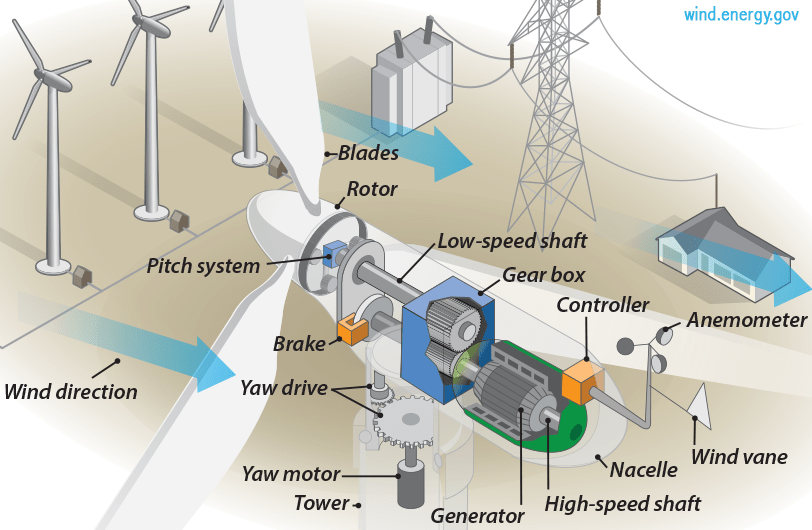
    And here is the more detailed explanation: the Wigton wind farm consists of three separate installations namely, Wigton I, II and III. Wigton I, for example, consist of 23 NEG Micon NM52 – 900 kW wind turbines to give a total capacity of 20.7 MW. The electric generators are asynchronous (induction) generators. Therefore the rotor must turn faster than the synchronous speed of the electricity grid to generate power for the grid. Otherwise, if connected, it will consume power from the grid and in turn, operates like a Big Fan.

    The following diagram shows how power is generated by these massive turbines and is routed to the public electricity grid:

    image002

    The NEG Micon NM52 – 900 kW wind turbine contains 2 generators (double speed), as shown, based on an old Dutch manufacturing principle. The basis of which, is to optimize power generated at both low and high wind speeds. The small generator (g) generates power in the range 0 – 200 kW, while the large (G) generator generates power in the range 200 – 900 kW.

    When the wind speed is such that the turbine-generator reaches the number of revolutions needed to generate electric power a thyristor-based circuit breaker connects the generator to the electricity grid in a fashion known as soft connection. The thyristors are bypassed by mechanical switches if more than 50 kW of power is generated to avoid excessive stress on the thyristors. 

    The two generators cannot be connected at the same time. This is because the large generator is a 4-pole generator which must run at just over 1500 rpm (the synchronous rotational speed for a 4-pole machine). The small generator is a 6-pole generator which must run at just over 1000 rpm (the synchronous rotational speed for a 6-pole machine).

    At low wind speeds, i.e under 8 m/sec, the wind turbine starts up on the small generator. If the wind now freshens, it automatically connects to the large generator by disconnecting from the small one, “speeding up” and connecting to the large generator.

    Conversely, if the wind has been strong for a long time and suddenly drops, it is no longer worthwhile running on the large generator, and therefore the small generator is reconnected by folding out the blade tips and applying the rotor brake. Once revolutions have been reduced to a suitable level for the small generator, the process of connecting the small generator is started.

    These wind turbines do not always start up on the small generator. If the wind speed is 8-9 m/sec, as measured by an anemometer, the wind turbine will start up directly on the large generator completely by-passing the small one.

    So there you go….! No power is generated to the electricity grid until the generator is forced by the wind to run faster than its synchronous rotational speed, i.e. the rotor will run a little faster than the rotating magnetic field in the stator. And if the generator was already connected and wind stops or the drops below the cut-in speed of the turbine, the generator is disconnected from the grid.

    Thanks again to Wigton Windfarm Limited for taking the time to answer my question and to provide the technical details about the operating principle of their NEG Micon wind turbines…. I hope this helps if you have the same “stupid question (for an electrical engineer)” that I had the heart to ask!