Tag: Solar

  • Weighing in on T&T’s 10% RE Target

    Weighing in on T&T’s 10% RE Target

    Trinidad and Tobago (T&T), has set an ambitious renewable energy (RE) target of 10% of installed capacity by 2021. This equates to approximately 200 MW given the combined installed capacity of the two islands is over 2000 MW of natural gas based power generation.

    T&T is the only nation in the western hemisphere, and the second in the world, that generates 100% of its electricity needs from natural gas. Therefore, unlike the other islands in the Caribbean T&T is already energy independent, since all the natural gas used is sourced locally through its sophisticated network of pipelines. As a consequence, T&T have seen the lowest and most stable electricity rates in the region over the last decade.

    Given that T&T is  already energy independent, the integration of renewables will have the effect of reducing the natural gas demand for electricity production and thereby increasing the levels available for export and/or for use in the well developed local petrochemical industry. This is now being championed by the energy sector as a means to increasing government revenues in a time when the nation is witnessing a significant decline in revenues and consecutive budget deficits.

    We decided to weigh in on the potential savings to be derived from this level of renewable energy integration. In order to do this we first had to assume a mix of renewable energy technologies. Since the objective is to use renewables as a means to reduce the consumption of a natural gas and thus increase government revenues, it thus implies that the 200 MW will come from utility scale renewable energy projects only.

    We therefore opted to break up the 200 MW into 120 MW of onshore wind, 60 MW of solar pv and 20 MW of waste to energy. No consideration is given to the technical feasibility of this RE mix. There are, however, ongoing discussions on the subject of undertaking solar and wind resource assessments and there are currently no known technical barrier limiting grid connection.

    As the based case, we looked at Jamaica, which has over 150 MW of utility scaled renewables connected to the grid, to formulate a case for wind and solar in T&T. In 2016, Jamaica commissioned 60 MW of wind and 20 MW of solar capacity at a cost of approximately US $200 million.

    If we use the 36 MW BMR Wind Farm in Jamaica, commissioned in 2016 at a cost of US $90 million, as an example then, 120 MW of utility scale onshore wind capacity should not cost T&T more than US $300 million in 2018, given that the capital cost of onshore wind fell by 20% between 2010 and 2017. Conservatively, 120 MW of wind can generate 285,000 MWh annually, thus avoiding the use approximately 2,850,000 MMBTU of natural gas annually for the production of electricity.

    Similarly, if we use the 20 MW Content Solar Farm in Jamaica, also commissioned in 2016 at a cost of US $63 million, then 60 MW of utility scale Solar PV should not cost T&T more than US $190 million in 2018, since the capital cost of solar PV fell by 68% between 2010 and 2017. 60 MW of solar can conservatively generate 95,000 MWh annually, thus avoiding the use of approximately 950,000 MMBTU of natural gas annually.

    There has been some discussion around the potential of a waste to energy (WtE) facility at the country’s largest landfill, located on the outskirts of the capital city. The Solid Waste Management Company (SWMCOL) estimates that the landfill receives approximately 1000 tonnes of uncharacterized waste daily. We estimate that a 20 MW WtE facility can be developed at the proposed site to produce energy for the national grid.

    Using the information on the Solid Waste Authority of Palm Beach County Renewable Energy Facility 2 (REF2), a 100 MW mass burn WtE facility commissioned in 2015 at a cost of US $672 million, we assume, therefore, that a similar facility rated at 20 MW should not cost T&T more than US $150 million. Given that a mass burn WtE facility is a steam power plant at its core, then a 20 MW plant should generate approximately 150,000 MWh annually and thus avoiding the use of approximately 1,500,000 MMBTU  of natural gas annually.
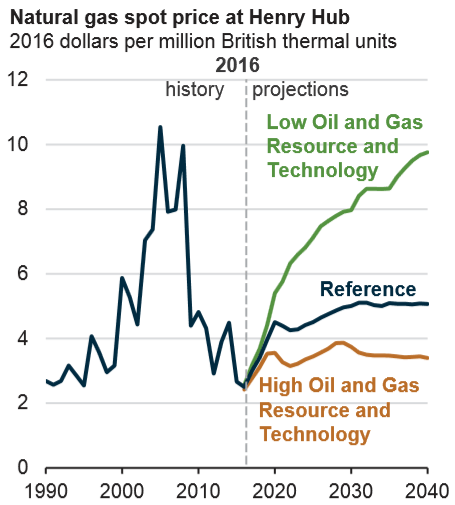
    natural gas price projections

    Therefore, from our selected portfolio of renewables we see that the potential exist to avoid approximately 5,300,000 MMBTU of natural gas annually. However, this does not come cheap as total investment cost estimates to US $640 million. The chart to the left shows the projected price of natural gas up to 2040.

    If we therefore look at the pessimistic case, we see that the price of natural gas in the US is projected to vary between US $3.00 to $4.00 over the remaining period and averages about US $3.50. Using this price we estimate a potential earning of US $18.6 million annually. The optimistic outlook, on the other hand, shows an average price of approximately US $6.80 resulting in a potential earning of US $36 million per annum.

    Both the pessimistic and the optimistic outlooks gave very large negative net present values using a 10% discount rate over a 20 year period. The optimistic case only gave a positive net present value for a discount rate of about 1%.  The analysis assumes that the projects would be government owned and did not take into consideration the operation and maintenance cost over the life of the project. Overall, it shows that the projected revenues to be derived from the sale of the avoided natural gas on the open market will not return the capital invested over a 20 year horizon.

  • Make ‘Electricity’ while the Sun Shines

    Make ‘Electricity’ while the Sun Shines

    In a recent post, titled solar basis, I gave a quick overview on solar energy and its conversion into other, more useful, forms of energy (e.g. electricity). In this article however, I will delve a little into solar electric systems. But before I jump into it, I will briefly recap from that article what I think might be relevant here for those of you who did not read it as yet.

    Solar Thermal (left) and Solar Electric (right) (www.blog.thesietch.org)

    As outlined in the article, solar energy systems fall into two main categories: 1) solar thermal systems, which uses the thermal energy from the sun to heat a working fluid that in-turn can be used for heating and cooling in buildings (e.g. solar hot water heaters) or for electricity generation (e.g CSP’s) and 2) solar electric systems, which uses the concept of photoelectric to convert the light (irradiation) from the sun directly into electricity (e.g. photovoltaic cells). The later is of interest here and thus from here on out will be referred to as solar photovoltaic (PV) systems.

    The main components of a solar PV system is the PV Cells, which are grouped together to form a single PV Module. In solar installations several of these PV modules are typically connected (in series) to form an Array, as show in the diagram that follows.


    The PV cells themselves are semiconductor electronic devices that convert the sunlight directly into electricity and thus forms the heart of a solar PV power generation system. The modern form of the PV cell was invented in 1954 at Bell Telephone Laboratories.

    Currently, solar PV systems are one of the most “democratic” renewable technologies available. This is as a result of their modular size, which puts them within the reach of individuals and small-businesses who want to access their own power generation and lock-in electricity prices.

    Solar PV technology offers a number of significant benefits, including:

    • Solar power is a renewable resource that is available everywhere in the world.
    • Solar PV technologies are small and highly modular and can be used virtually anywhere, unlike many other electricity generation technologies.
    • Unlike conventional power plants using coal, nuclear, oil and gas; solar PV has no fuel costs and relatively low operation and maintenance (O&M) costs. PV can therefore offer a price hedge against volatile fossil fuel prices.
    • PV, although variable, has a high coincidence with peak electricity demand driven by cooling in summer and year round in hot countries.

    A wide range of PV cell technology is now available on the market, using different types of materials. PV cell technologies are usually classified into three generations, depending on the basic material used and the level of commercial maturity:

    • First-generation PV modules (fully commercial) uses a wafer-based crystalline silicon (c-Si) technology, either single crystalline (sc-Si) or multi-crystalline (mc-Si).
    • Second-generation PV systems (early market deployment) are based on thin-film PV technologies and generally include three main families: 1) amorphous silicon (a-Si) and micromorph silicon (a-Si/μc-Si); 2) Cadmium-Telluride (CdTe); and 3) Copper-Indium-Selenide (CIS) and Copper-Indium-Gallium-Diselenide (CIGS).
    • Third-generation PV systems include technologies, such as concentrating PV (CPV) and organic PV cells that are still under demonstration or have not yet been widely commercialised, as well as novel concepts under development.

    On average a PV cells life expectancy is 25 years and the cells are able to harness both direct and diffuse radiation from the sun. The amount of energy harnessed depends on the type of semiconductor material used in the solar cells, ambient operating temperature,  cloud cover, shading, tilt angle and the direction in which the PV modules are installed. As the earth rotates continuously, PV cells which have sun ‘tracking’ capability are able to harness more energy. Jamaica and Barbados is located 18 and 13 degrees north of the equator respectively, thus it is a recommended best practice to install PV modules facing south at an angle of 18 and 13 degrees respectively.

    Some simple questions to ask yourself before investing in Solar Energy:

    • How readily available is the natural resource – sunshine? How readily can you access it – shading etc?
    • Why are you interested in implementing a solar PV system – high cost of electricity or you are environmentally conscious?
    • What is the initial cost of implementing a solar PV system in your area – total cost and the cost of the individual components?
    • What is the maintenance requirements of your system of choice and estimated cost to maintain it?
    • Where can you install your PV system – on the roof or in your yard?
    • What is the warranty periods offered on PV modules, and other components of the system?
    • What are the impacts on the natural environment? Will it reduce your carbon footprint or contribute to other environmental issues?

    The answers to most of the questions are pretty much straight forward. My final line to you is that solar PV is one of the fastest growing renewable energy technologies today and it is expected that it will play a major role in future global electricity generation mix. So embrace your future today, by making steps to start generating your own electricity as the sun shines!

    feel free to register your comments below….