In 2013, WBR Enterprises Inc. was selected by the Office of Utilities Regulation (OUR) via a competitive bidding process to develop a 20 Megawatts (MW) solar farm – the island’s first utility-scale solar project. The project was the third lowest bid received, in response to the OUR’s request to supply 115 MW of renewable generation, with a proposed price of US$0.1880 per kilowatt-hour (kWh) to deliver renewable energy to the national grid.
On September 18, 2014, WBR subsidiary, Content Solar Ltd., signed a 20-year power purchase agreement (PPA) with the Jamaica Public Service Company (JPS) to sell the full output of its solar farm to the grid.
The 154 acres solar farm, coined Solar Content, subsequently broke ground in Content Village, York Town, Clarendon on July 9, 2015. The $63 million (US) project was financed in part by a $47 million debt agreement with the Overseas Private Investment Corporation (OPIC) and the U.S. Government’s Development Finance Institution for the development. Sponsor equity was provided by WRB Serra, a strategic partner of WRB Enterprises and WRB Energy focused on sustainable infrastructure investments in the Caribbean and Latin America. The Content Solar plant is the second OPIC-financed project in support of the U.S. Caribbean Energy Security Initiative.
It is worthy of noting here that, the Content Solar plant is the second OPIC-financed project in support of the U.S. Caribbean Energy Security Initiative. The first being the blue mountain renewable (BMR) 36MW Wind Farm also located in Jamaica.
And in a historic move on August 28, 2016, the Content Solar farm was launched into commercial operations as Jamaica’s first utility-scale solar PV plant. The plant which boasts 97,000 solar panels will power more than 20,000 households over the next 20 years under the PPA with JPS.
According to the Jamaica’s National Energy Policy 2009-2030, the country is looking to significantly increase investments in renewable energy technologies. The country has targeted at least 20% contribution towards the energy mix from renewable energy sources by 2030. The content solar farm pushes Jamaica’s installed renewable capacity to approximately 152 MW or 14.8%.
Jamaica second utility-scale solar project, the Eight Rivers 33 MW solar farm, is currently ongoing and is estimated to be put into commercial operation by the end of 2018. The commissioning of Eight Rivers project will see jamaica’s renewable energy mix at 17.5%. The planned 190 MW LNG power plant in Old Harbour Bay, St Catherine, which is expected to be completed in early 2019, will change this mix.
These are certainly exciting times in Jamaica’s electricity market environment as they seek to lower the cost of electric energy in a bid to improve the country’s socio-economic conditions.
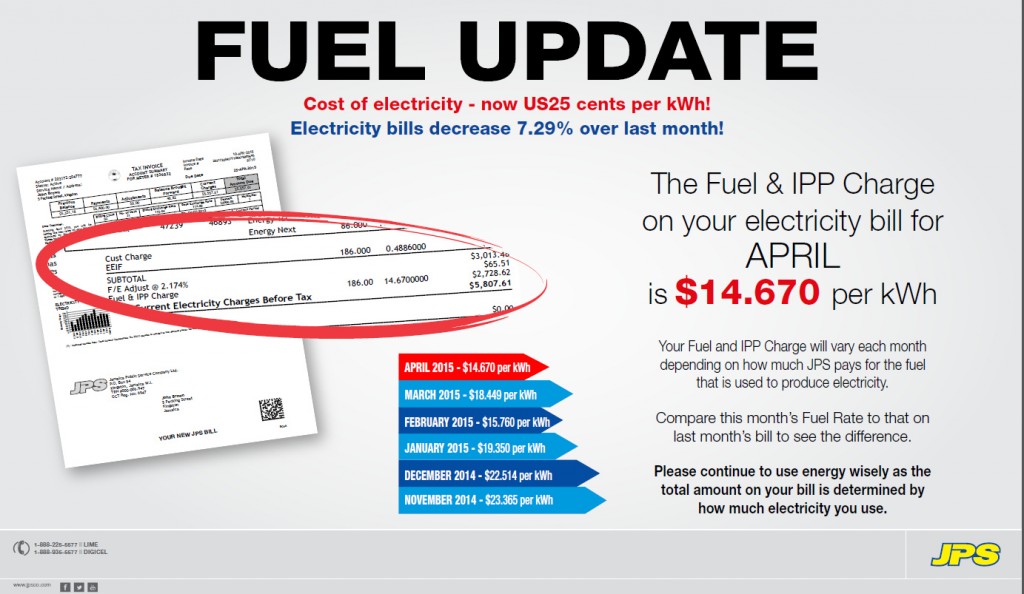
The Fuel & IPP Charge on your bill combines two factors: 1) The cost of fuel used to generate electricity and 2) The cost of the electricity supplied by Independent Power Producers (IPPs). The fuel cost is by far the greatest (more…)
The average cost of the electricity in Jamaica is currently at a five year low of US 25 cents per kilowatt-hour (kWh), according to the privately owned electricity company (Jamaica Public Service). JPS says the dramatic (more…)
As some of you may already know, JPS has made an application to the OUR for an increase in its non-fuel tariff rates. This was done in accordance with their exclusive all-island electricity licence, which stipulates that JPS must submit a filing with the OUR to obtain new rates at the end of every five year period. The licence also allows for a monthly adjustment due to foreign exchange changes and an annual adjustment to cater for inflation.
Data obtain from the MSTEM showed that over the last period 2009 to 2013, JPS has increased its rates on average by 15% annually for each class of customer, as shown in the chart above. In its recent submission for the period 2014-19, while acknowledging that Jamaica and by extension its customers are experiencing an economic contraction, JPS proposes a massive 21% increase in the average residential customers electricity bill. The average commercial customer will also see an increase of 15%, while the average industrial customer will see a small 1.5% reduction.
Be that as it may, the proposed 21% hike in residential electricity bill has definitely sparked my interest. It did so to the point that I decided to take a quick glance through their application document (feel free to take a look). As a result, I decided to present some of the information that I think will give you’ll a heads up on what your bill might look like if the OUR approves the proposal as is (and for simplicity I focused only on the residential class, since that affects all of us).
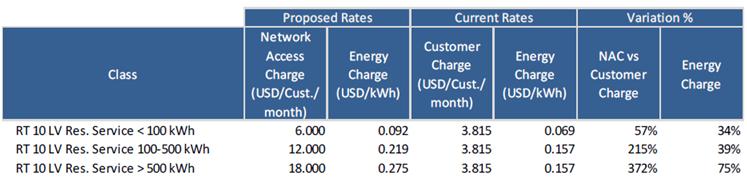
The following table shows the proposed rates in addition to the current ones in US dollars ($1 US = $112 JM). Note that the residential customer class is divided into three tiers, as shown in the left column.
A a network access charge is now being proposed to replace the customer charge. This change brings with it a hefty increase, up to 372%. Is this ridiculous or not?
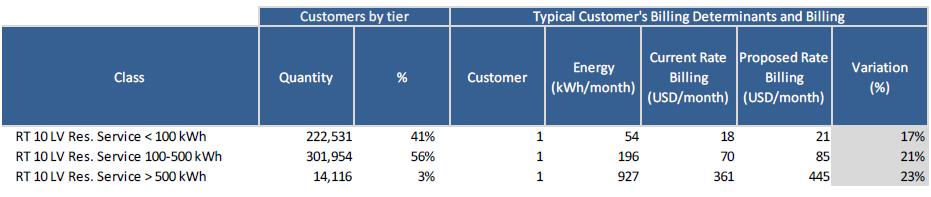
The next table shows the percentage increase to be expected on average per tier. It also showed that the average consumption per tier is 54, 196 and 927 kWh (this is the unit used to measure you electricity usage) and the monthly expected increase is 17, 21 and 23% respectively. So that’s where the 21% stated above and in the print media came from.
To put this into prospective, say for example that you are the average customer in the second tier (100-500kWh) with monthly energy consumption of 196kWh, you current bill would be $7,891.00 per month. However, after the increase you new bill would be $9,567.00 per month. This plus the bill impact of the other tiers are shown in the following table:
The document is a detailed and lengthy one and though I did not get the time to digest the content in its entirety, I can’t help but feeling that JPS is shifting too much of the burden unto the residential and small commercial customers while at the same time lowering the cost to large commercial and industrial customers. This they say is in a bid to “provide an attractive tariff to the largest industrial customers to encourage economic growth and development for the country.”
However, my gut feeling is telling me that this a trap engendered to keep customers connected to the grid. How? Firstly, the lowering of the tariff for large commercial and industrial customers will be a disincentive to the utilization of the wheeling/net-billing policies, since this will affect the economics gains of these options. And secondly, smaller customers are less likely to afford to go off the grid or put another way the economic gains are negligible.
What are your thought? Feel free to comment below or inbox me via the about page.
JPS posted on Linkedin that they are “the #1 investor in renewable energy in Jamaica.” Is there any truth to this? No there isn’t! See my comment and their follow-up comment below. The Petroleum Corporation (more…)
This has never been done before, at least not by me! In this post I will attempt to break down and assess, for the purpose of the readers, JPS’s Annual Tariff Adjustment Submission to the OUR (Office of Utilities (more…)
Solar energy technology continues to advance both in terms of efficiency and cost. The cost, however, is still outside the reach of the average hardworking middle class of our society. The need for alternative (more…)
Jamaica, the paradise island that is sometimes referred to as “the land of wood and water,” has great hydroelectric potential due primarily to its many rivers, land topography and climate. Out of a list of 120 rivers, the Island has several rivers that are suitable for hydroelectric power generation.
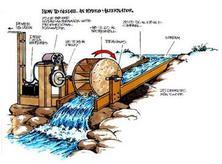
run-of-river hydroelectric plan
Hydroelectric power is power generated from water. A basic hydroelectric power plant generates electricity in a three-stage process: First, water wheels are used to capture the kinetic energy (energy of motion) from falling or running water. Next, this kinetic energy is converted into mechanical energy by a gear mechanism attached to the water wheel. Then finally, the mechanical energy is converted into electrical energy by an alternator that is connected to the gear mechanism.
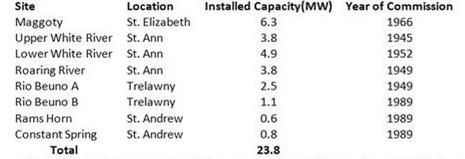
For over 100 years Jamaica has been exploiting its hydroelectric potential through the use of “run-of-river” hydroelectric power plants. There are currently eight (8) such plants in operation across the island today:
These plants are owned and maintained by Jamaica Public Service Company (JPSCo.). Together they produce approximately 5% baseload capacity for the public electricity grid during the rainy seasons. Most of these systems are fairly old, however, with the youngest ones being more than 15 years old. These eight hydroelectric power stations save the country roughly US$27M on fuel imports annually. The following chart shows historical data of hydroelectric power generation in Jamaica:
In April 2011, the JPSCo unveiled plans to undertake the first major hydroelectric development in Jamaica in 30 years. This involves the commissioning of a new plant that will further reduce the country’s oil import by 48,000 barrels of fuel per year. At an estimated price of $100 per barrel, this would save Jamaica US$4.8M annually. The new plant, which will see the doubling of the capacity at the Magotty Hydroelectric Plant, is scheduled for completion by July 2013.
The Petroleum Corporation of Jamaica (PCJ) has shown through studies that Jamaica’s hydroelectric potential could be further exploited through the construction of a number of small-scale plants. The total technical potential is estimated to be in the range of more than 56 MW, including one large-scale facility at Back Rio Grande, as shown below.
While the technical feasibility was proven in most cases, the economic assessment resulted in negative decisions in the past due to the high investment costs involved and comparatively low electricity generation costs from conventional plants. However, with the hike in oil prices (currently at US$99.87 per barrel) resulting in an increase in electricity generation costs, this picture is changing as can be seen from JPS’s recent decision to expand the capacity of the Maggoty Plant.
Currently, the PCJ’s Centre of Excellence for Renewable Energy (CERE) division that has been mandated to support the implementation of new ideas and methods in renewable energy in Jamaica is pursuing several hydroelectric initiatives. The CERE has partnered with two international companies to update the technical, financial and economic feasibility study on five potential hydroelectric projects (listed below). CERE has partnered with BPR’s Power Division in four of the five projects and IT Power Ltd. in the other. BPR is a private engineering consulting firm located in Quebec, Canada, and IT Power Ltd. is a climate change consulting firm located in the United Kingdom.
1. The Back Rio Grande Hydropower Plant: Back Rio Grande is located in the parish of Portland at the north eastern end of the island.
Project Highlights – Back Rio Grande Potentials:
6 MW of electricity potential
17,120 MWh of electricity per year
10,000 barrels of avoided oil imports
14,000 tonnes of CO2 emission reductions
Foreign Direct Investment US$20.7 million
2. The Great River Hydropower plant: Great River borders the parishes of St. James and Hanover, on the north western coast of the island.
Project Highlights – Great River Potentials:
8 MW of electricity potential
35,218 MWh of electricity per year
21,000 barrels of avoided oil imports
29,000 tonnes of CO2 emission reductions
Foreign Direct Investment US$23.6 million
3. The Laughlands Hydropower Plant: Laughlands Great River, a Greenfield site, is located in the parish of St. Ann, on the north coast of the island.
Project Highlights – Laughland Potentials:
2 MW of electricity potential
13,920 MWh of electricity per year
8,000 barrels of avoided oil imports
12,000 tonnes of CO2 emission reductions
Foreign Direct Investment US$6.7 million
4. The Rio Grande (1 & 2) Hydropower Plants: Rio Grande is located in the parish of Portland at the north eastern end of the island.
Project Highlights – Rio Grande Potentials
2 MW of electricity potential
8,425 MWh of electricity per year
5,000 barrels of avoided oil imports
7,000 tonnes of CO2 emission reductions
Foreign Direct Investment US$6.8 million
5. The Swift River Hydropower Plant: Swift River is a tributary of the Rio Grande, located in the parish of Portland at the north eastern end of the island.
Project Highlights – Swift River Potentials
2 MW of electricity potential
8,390 MWh of electricity per year
4,900 barrels of avoided oil imports
6,900 tonnes of CO2 emission reductions
Foreign Direct Investment US$6.5 million
These feasibility studies now open up the door for members of the private sector to step in and play a bigger role in leading the way forward towards the uses of cleaner, and cheaper sources of electricity. Private investors should, however, be aware that current legislation requires a license for all types of water uses, issued by the Water Resources Authority. The license is granted for a period of 5 years but can be extended thereafter. In competing situations, preference is given to fresh-water use over any energetic purposes. All environmental aspects have to be approved by the National Environment Protection Agency (NEPA).


 On September 18, 2014, WBR subsidiary, Content Solar Ltd., signed a 20-year power purchase agreement (PPA) with the Jamaica Public Service Company (JPS) to sell the full output of its solar farm to the grid.








 xenogyre.com