Category: Energy

  • Guyana to install 33 MWp of Grid-scale Solar PV + Storage

    Guyana to install 33 MWp of Grid-scale Solar PV + Storage

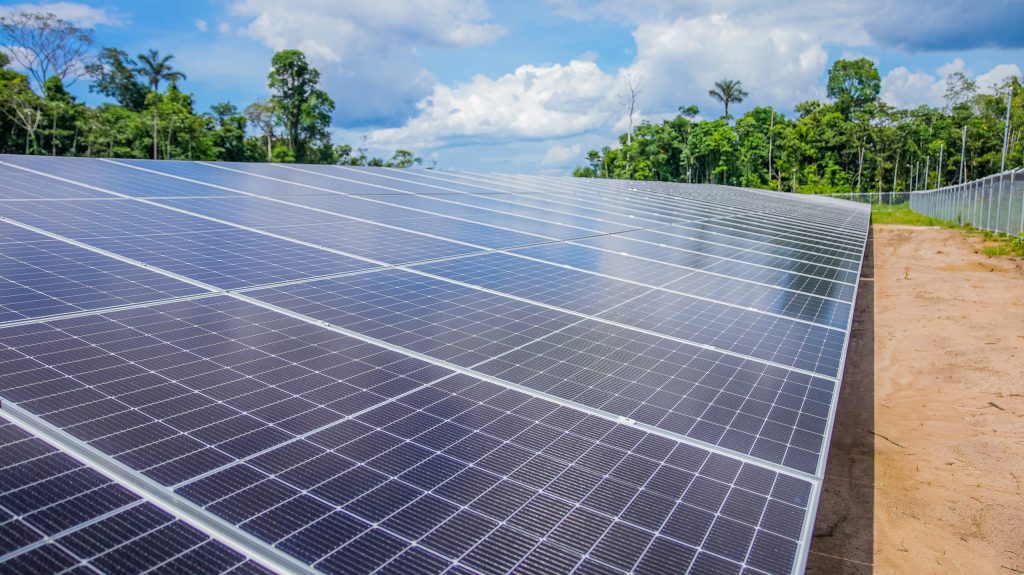
    Guyana plans to install 33 MWp (megawatt peak) of grid-scale solar PV with battery storage in three of its un-interconnected (isolated) grids.

    The Government of Guyana (GoG), notwithstanding the Country’s evolving oil and gas sector, is committed to the development of a cleaner, greener, and more diversified energy matrix that is based on indigenous resources as outlined in its recently published 2030 Low Carbon Development Strategy (LCDS). Aside from having the capacity to utilize hydropower, wind, and biomass, Guyana has significant solar PV potential.

    Guyana has a long-term average global horizontal irradiance (GHI) of 5.0-5.9 kWh/m2 (kilowatt-hours per square meter) per day, based on satellite data. To put things in perspective, Germany, which has approximately 6.8% of the world’s installed solar PV capacity at the end of 2021, has very few locations with a GHI above 3.5 kWh/m2/day.

    As such, the GoG has given the Guyana Power and Light Inc. (GPL) the mandate to utilize NORAD funding to execute a national solar photovoltaic (PV) project in alignment with its plans to increase renewable energy penetration and grid stability on the power system. The project will be administered through the Inter-American Development Bank (IDB) with GPL being the execution agency

    The program is targeting eight projects totalling 33 MWp of solar PV in three of the country’s grids (Guyana has several un-interconnected grids) as follows:

    • 15 MWp with a 15 MW, 1hr Battery Energy Storage System (BESS) in the Linden Isolated Power System (LIS),
    • 8 MWp with an 8MW, 1hr BESS in the Essequibo Coast Isolated Power System (EIS), and
    • 10 MWp in the Demerara-Berbice Interconnected System (DBIS)

    The Linden project

    The Linden project will involve three (3) PV farms, each rated at 5 MWp. The plants are proposed to be located at Block 37 (in the vicinity of Bamia on the Linden Soesdyke Highway), Retrieve on the eastern side of the Demerara River, and Dacoura on the western side of the Demerara River.

    The Block 37 plant will be interconnected to the Amelia’s Ward 13.8 kV feeder, whilst the Dacoura plant will be interconnected to the Wismar 13.8 kV feeder. The Retrieve plant will, however, be interconnected directly to the 13.8 kV Retrieve substation.

    In addition, given the high level of penetration, a total of 15 MW (megawatt), with a minimum duration of 1 hour, of battery energy storage system (BESS) will also be installed and interconnected to the Linden system for stability purposes.

    The Linden project will initially satisfy approximately 38% of the demand with an average annual generation of 20.12 million kWh (kilowatt-hour). This will result in approximately 17,182 tons of CO2 (carbon dioxide) being avoided annually.

    The Essequibo Coast project

    The Essequibo Coast project will involve two (2) PV farms, rated at 4.4 and 3.6 MWp. The plants are to be located at Ondereeming and Lima Sands, respectively.

    The Onderneeming plant will be interconnected to the South 13.8 kV feeder, while the Lima Sands plant will be interconnected to the North 13.8 kV feeder.

    Much like the Linden project, given the high level of penetration, a total of 8 MW (megawatt), with a minimum duration of 1 hour, of BESS will be installed and interconnected to the Essequibo Cost system for stability purposes.

    The Essequibo Coast project will initially satisfy approximately 28% of the demand with an average annual generation of 12.36 million kWh, which will result in approximately 9,390 tons of CO2 being avoided annually.

    The Berbice Project

    The Berbice project will involve three (3) PV farms. A 4 MWp plant at Trafalgar on the west coast of the Berbice; a 2 MWp plant at Prospect on the east coast of the Berbice; and a 4 MWp plant at Hampshire in Corentyne, Berbice.

    The Trafalgar and Prospect farms will interconnect via an express 13.8 kV line to the 13.8 kV busbar at the Onverwagt and Canefield substations respectively. The Hampshire farm will interconnect to the Canfield F3 13.8 kV feeder.

    These plants will be a part of the DBIS and will satisfy a very small portion of the demand of the DBIS. However, the distributed nature of the project will serve to support the distribution network and reduce losses by supplying power closer to the end user.

    The plants will generate approximately 16.14 million kWh annually, which will result in the avoidance of 10,671 tons of CO2 annually.

    The estimated energy production and land requirements for each plant are shown in Table 1 below.

    SitePlant Size (MW)SystemYearly PV Energy
    Production (MWh)
    DC Capacity FactorLand Requirement
    (acres)
    Prospect, East
    Coast Berbice
    3.0DBIS4,8421815
    Hampshire, East
    Coast Berbice
    3.0DBIS4,8421815
    Trafalgar, West
    Coast Berbice
    4.0DBIS6,4591820
    Lima Sands,
    Essequibo Coast
    3.6EIS5,5601818
    Onderneeming, Essequibo Coast4.4EIS6,7951822
    Block 37, Linden5.0LIS6,7071515
    Retrieve, Linden5.0LIS6,7071515
    Decoura, Linden5.0LIS6,7071515
    Table 1

    Project Funding

    All eight projects form part of the Guyana Utility-scale Solar Photovoltaic Program (GUYSOL) and will be funded through the Norwegian Agency for Development Cooperation (NORAD) Fund. The non-reimbursable funding, which amounts to US$83.3 million is structured as shown in Table2:

    Table 2

    The deadline for commencement of the works under the program is two years, counted from the effectiveness of the Non-reimbursable Financing Agreement, which was signed on 13th September 2022 and made effective as of the 15th June 2022.


  • Jamaica’s RE Near Term Outlook

    Jamaica’s RE Near Term Outlook

    The Jamaican electricity sector has seen its fair share of investment in renewable energy over the last two decades or so, to the tune of approximately US$360 million to be exact.

    Development to date:

    Jamaica has a long history of using its indigenous renewable sources of energy to generate electricity. This dates back as far as 1955 when the Upper White River hydroelectric power plant was inaugurated. The recent thrust to incorporate other forms of indigenous renewable sources of energy into the country’s energy mix started with the installation of a 225 kW wind turbine in 1996 at the Munro College campus, in St. Elizabeth, some fifty years later.

    The success of the Munro installation led to the development of the country’s first commercial wind farm in 2004, the 20.7 MW Wigton I plant located in the neighbouring parish of Manchester. The plant had its fair share of issues, ranging from technical to financial, but the experience gained led to an 18 MW expansion in 2010, dubbed as Wigton II. In 2010 the utility company, the Jamaica Public Service (JPS) Company, also completed its first wind farm, a 3 MW plant located in close proximity to the Munro campus.

    The publishing of the country’s national energy policy in 2009 and it’s draft renewable energy policy in 2010 prompted the development of several renewable energy projects. The first was a 7.2 MW expansion of JPS’s Maggotty hydroelectric plant in 2014. Then in 2016, the country witnessed the largest commissioning of renewable energy plants in a single year, closing out the year with a whopping total of 80 MW. This consisted of the 24 MW expansion of the Wigton Wind Farm (Wigton III), the 36 MW privately owned Wind Farm in St. Elizabeth, and the 20 MW Solar Farm in Clarendon, also privately owned.

    A near term outlook:

    The next renewable energy project on the horizon is the 33.1 MW Eight Rivers Solar Farm in Paradise Park, Westmoreland. In 2015, this project was selected by the Office of Utilities Regulation (OUR) from a list of 19 bids, received in response to a request for proposal (RFP) for renewable energy with capacity up to 37 MW. The privately-owned solar farm broke ground last month and is expected to be completed by December 2018 at an estimated cost of US$48.7 million dollars.

    Once completed this solar farm will be the second, but largest, solar installation on the island and it will feed electricity into the JPS grid at US$0.0854 per kWh. At this feed in rate, which is less than half that of the other solar farm on the island, this project has proven that renewable energy projects can rival conventional generation and it sets a new price ceiling for future renewable energy projects in Jamaica.

    Though the potential for wind energy on the island has not yet been exhausted, the Petroleum Corporation of Jamaica (PCJ), the parent company of Wigton Windfarms Ltd, is seeking to quantify the country’s offshore wind potential. The PCJ applied for and was awarded, in October of last year, a grant from the United States Trade and Development Agency (USTDA) to undertake a feasibility study of the island’s offshore wind potential. Preliminary work should have started during the final quarter of 2017 and the study is scheduled to last for 12 months. Should it proves feasible and leads to the development of viable offshore wind farms; it will be another first for Jamaica and the wider Caribbean.

    Grid storage is also on the horizon if JPS is successful in obtaining the necessary approvals from the OUR. In May of last year, JPS sent out an RFP for the supply and installation of a 13 or 24.5 MW hybrid energy storage system. According to the light and power company, this system is required to smooth the effect of the intermittent renewable energy sources presently on the grid and also to provide other essential grid services such as frequency support, voltage support, and spinning reserve.

    Dubbed as a first of its kind in the Caribbean, this energy storage system will utilize a combination of high-speed and low-speed flywheels and containerized lithium-ion batteries and is to be located at the Hunts Bay Power Plant substation. Once approved by the regulator, it is expected to be completed by the third quarter of 2018 at an estimated cost of US$21 million.

    The Government is currently putting together an Integrated Resource Plan (IRP) with the intent to guide the development of a modern energy sector in Jamaica. The IRP is expected to establish the projected electricity demand over the next 20 year period, determine the generation capacity and technologies to be used to satisfy this demand, and to establish agreements on the transmission and distribution infrastructure to generate and deliver the needed electricity and the resulting tariffs.

    The IRP, which was originally slated for completion late last year, when completed will give all stakeholders, including the investment community, a clear view of the agreed suite of medium to long term investment opportunities necessary to achieve the island’s 2030 renewable energy target of 30%.

  • Marketing Renewable Energy Consultancy in Trinidad & Tobago

    Marketing Renewable Energy Consultancy in Trinidad & Tobago

    Renewable Energy (RE) is once again at the forefront both locally and internationally with the recent display of two opposing views, one by the Prime Minster of Trinidad & Tobago (T&T) versus another by the President of the United States of America (USA).

    The T&T Prime Minister, following his return from RE and Energy Efficiency (EE) conscious Chile, reaffirms his country’s commitment to the tenants of the 2015 Paris Climate Agreement, with specific objectives to be achieved via the reduction of the utilization of fossil fuels and the promotion of RE and EE. The American President, on the other hand, following his return from the recently concluded 2017 NATO summit in Belgium,  unexpectedly announced his country’s withdrawal from the same agreement.

    With these political decisions fresh in our minds, it is worth noting that the success of any RE & EE related product or service introduced into a market is not only based on the political environment but also on the effectiveness of the marketing plan designed for its promotion.

    The T&T RE Market in the past has been virtually non-existent with the present grid-connected RE sources accounting for less than 1% of all grid-connected generation. However, the prospects of the future RE market appear to be more favourable with the Government’s target of 10% Penetration of RE of the total forecasted Electricity Grid Capacity by 2021, specifically from Wind, Solar and Waste to Energy (WtE) technologies. It is expected that the Government will continue to take the lead in the local RE Market, with the implementation of fiscal incentives and amends the relevant legislations to allow for grid connection.

    It is expected that the Government will continue to take the lead in the local RE Market, with the implementation of fiscal incentives and amendments to the relevant legislations for grid connection. However, there will still be room for the introduction of private sector investment in distributed renewable generation sources (DRGS), such as domestic Solar Photovoltaic and Wind Turbine generators as a further means to increase T&T’s energy security and reduce our reliance on fossil fuels.

    Although there is now a more optimistic outlook of the T&T RE Market, further considerations must be made to the fact that (i) the market is still in its Infant Stage and (ii) the cost of fossil based energy in T&T is relatively cheap at less than US$0.06/kWh for Residential Customers and even cheaper energy charges for Industrial Customers with an additional Demand (kVA) Charge. These low rates would result in DRGS having payback periods in excess of 9 years, which renders them less attractive. Thus, a more paternalistic approach to managing the introduction of DRGSs to T&T via the provision of consultancy as a service to all segments of the market for more optimally engineered solutions is required. This RE Consultancy Service must be marketed as a convenience to the customer where it is the consultant who would determine the optimal engineering design and specification solution to the DRGS application that is desired by the customer.

    The effective marketing of RE Consultancy Services as a convenience for the customer is one of the pillars of roll out of DRGSs in T&T as it is essential for the removal of some of the existing barriers to entry the T&T RE Market. Even with the existing barriers to entry to the RE Consultancy Service T&T Market there are still a few RE Product Distributors that act as RE Consultants such as Smart Energy Ltd. and Solar Power Concepts Ltd. Thus the existing competitive landscape for RE Consultant Services is weak as there are just a few players who predominantly focus on Solar Technologies only. While the positioning of RE Consultancy Services should be one where the customer views engaging with a consultant before the initiating of any type RE Project solution being essential to its success.

    In that same vein, the success of the RE Consultancy Service Company is based on the marketing plan effectively defining the market segments. Failure to effectively segment the T&T RE Market for opportunities would result in:

    • Marketing to customers who are less willing to pay the premium for RE Consultancy;
    • Providing only a limited range of initiatives to appeal to customers; and
    • Using unfocused marketing techniques

    In addition to the typical criteria used to segment the market such as demographic, geographic, physiographic and product benefit criteria, the criteria should initially start with the RE type desired by the customer, followed by the maximum aggregate capacity of the DGRS into segments similar to the existing T&TEC Tariff Structure, for example:

    • Up to 5kW, for single phase, 3-wire, 115/230volt DGRS installations serviced under the Domestic and General Tariff (Rate A),
    • Up to 50kW, for single and three phase, 4-wire, 115/230volt DGRS installations serviced under the Commercial Tariff (Rate B),
    • 50kW to 200kW, for three phase, 4-wire 115/230volt DGRS installations serviced under the Industrial Tariff (Rate D1), and
    • Single DRGS with output greater than 200kW shall be installed for self-generation as stand-alone equipment which does not export to the Grid.

    In the end, the effective marketing of RE Consultancy Services according to the specific market segments would help to mold the perception and attitude towards DGRSs and assist achieving nationwide adoption of RE.


  • Island Energy Snapshots – the Caribbean

    Island Energy Snapshots – the Caribbean

    The Islands of the Caribbean are known to have some of the highest electricity rates in the world, with the exception of only a few. This is primarily because more than 95 percent of their energy consumption is derived from imported petroleum products.

    The U.S. Department of Energy and its partners, through the Energy Transition Initiative (ETI), has been working with government entities and other stakeholders to establish a long-term energy vision and successfully implement energy efficiency and renewable energy solutions. ETI provides a proven framework and technical resources and tools to help islands, states, and cities transition to a clean energy economy and achieve their clean energy goals.

    The Island Energy Snapshots is one of several outputs of the ETI. It highlights the energy landscape of islands in the Caribbean, the Pacific, and the surrounding areas. I have taken the liberty of presenting below links to the Energy Snapshots of the Islands in the Caribbean. In these four page documents are relevant and up to date information about the islands’ electricity sector, energy policies, and opportunities to reduce dependence on imported fossil fuels through energy efficiency and the use of renewable energy sources.

    For the Energy Snapshots of the Pacific Islands click here

  • The Economics of Wind Power in Jamaica

    The Economics of Wind Power in Jamaica

    In late 2013, the Office of Utilities Regulation (OUR) named three preferred bidders for the supply of up to 115 MW (megawatts) of electricity generation capacity from renewable energy. The three preferred bids amounted to a total 78 MW of energy only renewable energy capacity, including two projects offering energy from wind amounting to 58 MW, and one offering solar amounting to 20 MW. The proposed delivery price to the grid ranged from US$0.1290 to US$0.1880.

    The preferred bidders were:

    1. Blue Mountain Renewables LLC, to supply 34 MW of capacity from wind power at Munro, St. Elizabeth;

    2. Wigton Windfarm Limited, to supply 24 MW of capacity from wind power at Rose Hill, Manchester; and

    3. WRB Enterprises Inc., to supply 20 MW of capacity from Solar PV from facilities in Content Village, Clarendon.

    The 20 MW solar farm will be the first of its kind in the Island, however Jamaica’s first grid-connected wind-powered generator was commissioned in February 1996 at Munro College. This wind turbine-generator, a Vestas V27 – 225 kW, was also the first grid-connected wind-energy source in the English-speaking Caribbean. The project was funded primarily by the Environmental Foundation of Jamaica (EFJ), but also included a long list of local companies and individuals. The total installation cost of the facility was US$300,000. However, much of the local services, such as JPSCo’s services and Alpart’s crane services, were donated free of cost.

    The overwhelming success of the the Munro College wind turbine encouraged the Petroleum Corporation and the Government of Jamaica to commission Jamaica’s first large scale wind farm at Wigton (in the parish of Manchester) in 2004. The initial 20.7 MW wind farm, which came to be known as Wigton I, comprises of twenty three (23) NEG Micon NM52 – 900 kW wind turbines. The project was financed at a total cost of US$26.2 million with equity injection of US$ 3.2 million from the Petroleum Corporation of Jamaica (PCJ), a US$ 16 million loan from the National Commercial Bank of Jamaica (NCB) and a grant of US$ 7.0 million from the Netherlands Government.

    A midst several changes, including $150 million in lost revenues due to unfavorable energy rates and $120 million due to penalties imposed by JPS for reactive power demand and a fail divestment attempt in early 2007, the Wigton wind farm was expanded during the period 2009 to 2010 to include nine (9) Vestas V80 -2.0 MW wind turbines. The 18 MW project, now called Wigton II, was financed from the PetroCaribe Development Fund at total cost of US$49.9 million.

    In late 2010, JPS (the owner and operator) commissioned its first wind project – a 3 MW wind farm at Munro, St. Elizabeth. This project comprises of four (4) UNISON U50 – 750 kW wind turbines and was completed at a total cost of US$9.3 million.  The Munro wind farm interconnects to JPS 24kV distribution system unlike the Wigton wind farms, which interconnects to JPS 69kV system via a 11km long tie-line. It is worthwhile noting that the grid interconnection cost can account for as much as 8-9% of the total project cost. In the case of the Wigton wind farms the 11kM 69kV line was included in the capital cost of the initial project.

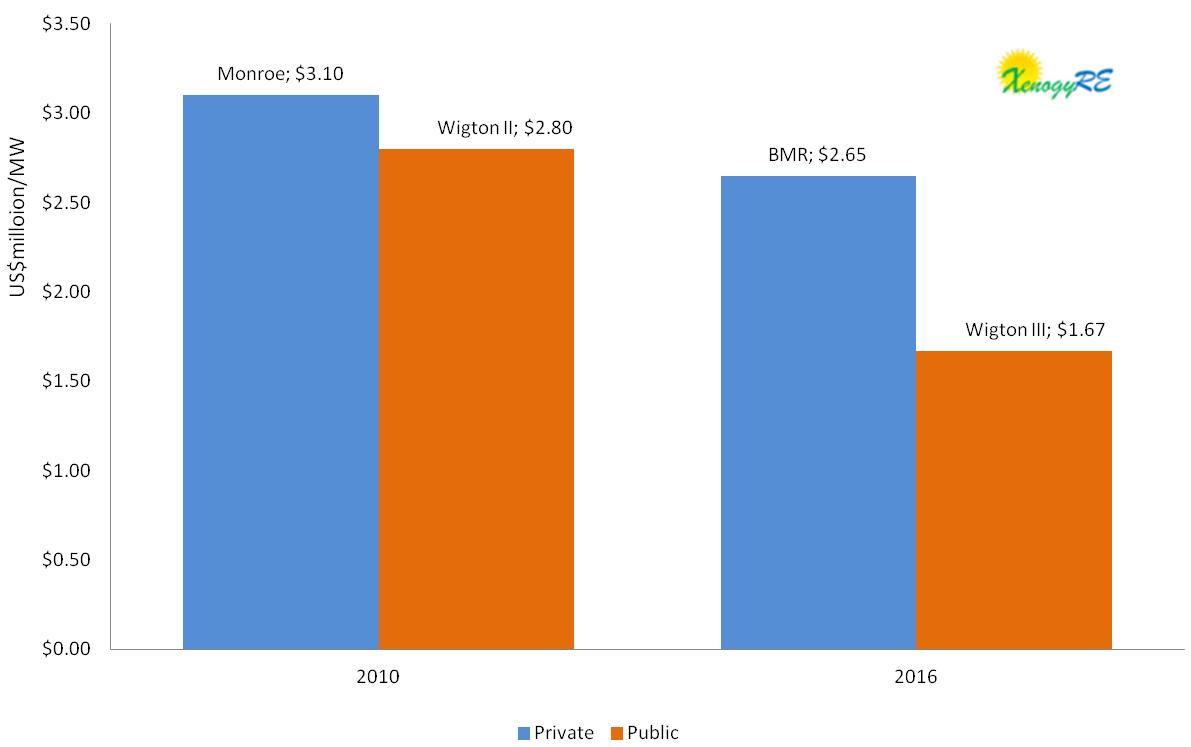
    The two new wind farms coming out of the OUR latest request for renewable energy in addition to the national grid are projected to cost US$40 million for the WWF’s (Wigton Windfarm) 24 MW wind farm and US$90 million for the BMR’s (Blue Mountain Renewables) 34 MW wind farm. The cost of these two project forces me to ask one key question “how does public vs private investor wind power projects costs compare?”. I thought that a good way to get a fair comparison was to look at the projects that had/have  the same/similar time horizon. So, I decided to firstly compare the Wigton II and JPS Munro wind farm projects (which were both commissioned in 2010) and secondly the proposed Wigton III and BMR Munro wind farm projects (both scheduled to be commission in 2016), as shown below.

    privatevspublic

    This comparison revealed two important facts:

    1. Private investor wind projects in Jamaica cost more than public wind projects. In the first case, the JPS Munro wind farm cost approximately 1.1 times the cost of the Wigton II wind farm on a per megawatt basis. Similarly, the proposed BMR Munro wind farm will cost approximately 1.6 times the proposed Wigton III wind farm on a per megawatt basis. It would be good to see a breakdown of the project cost to see exactly where the projects varied in term of cost.

    2. The cost of wind power has come down by 40% for public projects and 15% for private projects since 2009.

    Wind Capital Cost StructureThe cost of a wind project has a lot to do with its total size (economics of scale) however the most common way to compare wind project cost is on a per megawatt basis, as was done here. It is also worthwhile to add that the basic cost components of  wind projects typically include: turbine cost, grid interconnection, foundation, electrical installation, consultancy, financial cost, road construction, control systems, etc. The inserted table gives a break down of the % share of the total cost for each component.

    Public projects, in most cases, could have a competitive advantage in terms of the land rental, financial cost and road construction components which could possibly explain to some extent why public projects have been carrying lower project cost compared to the few private projects that we have seen in Jamaica’s recent renewable energy history.

  • JPS proposes massive residential rate increase!

    JPS proposes massive residential rate increase!

    As some of you may already know, JPS has made an application to the OUR for an increase in its non-fuel tariff rates. This was done in accordance with their exclusive all-island electricity licence, which stipulates that JPS must submit a filing with the OUR to obtain new rates at the end of every five year period. The licence also allows for a monthly adjustment due to foreign exchange changes and an annual adjustment to cater for inflation.

    Data obtain from the MSTEM showed that over the last period 2009 to 2013, JPS has increased its rates on average by 15% annually for each class of customer, as shown in the chart above. In its recent submission for the period 2014-19, while acknowledging that Jamaica and by extension its customers are experiencing an economic contraction, JPS proposes a massive 21% increase in the average residential customers electricity bill. The average commercial customer will also see an increase of 15%, while the average industrial customer will see a small 1.5% reduction.

    Be that as it may, the proposed 21% hike in residential electricity bill has definitely sparked my interest. It did so to the point that I decided to take a quick glance through their application document (feel free to take a look). As a result, I decided to present some of the information that I think will give you’ll a heads up on what your bill might look like if the OUR approves the proposal as is (and for simplicity I focused only on the residential class, since that affects all of us).

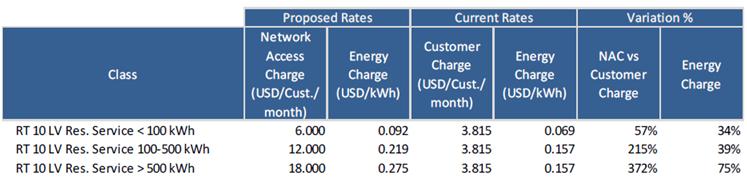
    The following table shows the proposed rates in addition to the current ones in US dollars ($1 US = $112 JM). Note that the residential customer class is divided into three tiers, as shown in the left column.

    table1

    A a network access charge is now being proposed to replace the customer charge. This change brings with it a hefty increase, up to 372%. Is this ridiculous or not?

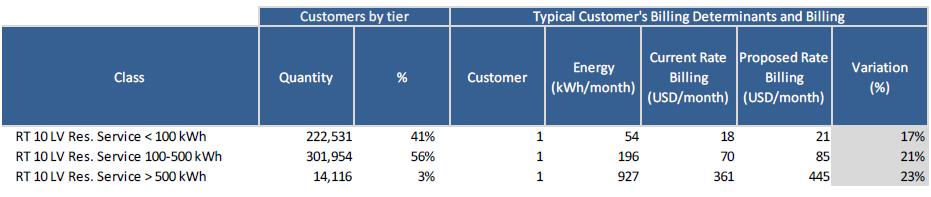
    The next table shows the percentage increase to be expected on average per tier. It also showed that the average consumption per tier is 54, 196 and 927 kWh (this is the unit used to measure you electricity usage) and the monthly expected increase is 17, 21 and 23% respectively. So that’s where the 21% stated above and in the print media came from.

    To put this into prospective, say for example that you are the average customer in the second tier (100-500kWh) with monthly energy consumption of 196kWh, you current bill would be $7,891.00 per month. However, after the increase you new bill would be $9,567.00 per month. This plus the bill impact of the other tiers are shown in the following table:

    table3

    The document is a detailed and lengthy one and though I did not get the time to digest the content in its entirety, I can’t help but feeling that JPS is shifting too much of the burden unto the residential and small commercial customers while at the same time lowering the cost to large commercial and industrial customers. This they say is in a bid to “provide an attractive tariff to the largest industrial customers to encourage economic growth and development for the country.”

    However, my gut feeling is telling me that this a trap engendered to keep customers connected to the grid. How? Firstly, the lowering of the tariff for large commercial and industrial customers will be a disincentive to the utilization of the wheeling/net-billing policies, since this will affect the economics gains of these options. And secondly, smaller customers are less likely to afford to go off the grid or put another way the economic gains are negligible.

    What are your thought? Feel free to comment below or inbox me via the about page.

    Thanks for reading!

    CP.