
Trinidad and Tobago (T&T), has set an ambitious renewable energy (RE) target of 10% of installed capacity by 2021. This equates to approximately 200 MW given the combined installed capacity of the two islands is over 2000 MW of natural gas based power generation.
T&T is the only nation in the western hemisphere, and the second in the world, that generates 100% of its electricity needs from natural gas. Therefore, unlike the other islands in the Caribbean T&T is already energy independent, since all the natural gas used is sourced locally through its sophisticated network of pipelines. As a consequence, T&T have seen the lowest and most stable electricity rates in the region over the last decade.
Given that T&T is already energy independent, the integration of renewables will have the effect of reducing the natural gas demand for electricity production and thereby increasing the levels available for export and/or for use in the well developed local petrochemical industry. This is now being championed by the energy sector as a means to increasing government revenues in a time when the nation is witnessing a significant decline in revenues and consecutive budget deficits.
We decided to weigh in on the potential savings to be derived from this level of renewable energy integration. In order to do this we first had to assume a mix of renewable energy technologies. Since the objective is to use renewables as a means to reduce the consumption of a natural gas and thus increase government revenues, it thus implies that the 200 MW will come from utility scale renewable energy projects only.
We therefore opted to break up the 200 MW into 120 MW of onshore wind, 60 MW of solar pv and 20 MW of waste to energy. No consideration is given to the technical feasibility of this RE mix. There are, however, ongoing discussions on the subject of undertaking solar and wind resource assessments and there are currently no known technical barrier limiting grid connection.
As the based case, we looked at Jamaica, which has over 150 MW of utility scaled renewables connected to the grid, to formulate a case for wind and solar in T&T. In 2016, Jamaica commissioned 60 MW of wind and 20 MW of solar capacity at a cost of approximately US $200 million.
If we use the 36 MW BMR Wind Farm in Jamaica, commissioned in 2016 at a cost of US $90 million, as an example then, 120 MW of utility scale onshore wind capacity should not cost T&T more than US $300 million in 2018, given that the capital cost of onshore wind fell by 20% between 2010 and 2017. Conservatively, 120 MW of wind can generate 285,000 MWh annually, thus avoiding the use approximately 2,850,000 MMBTU of natural gas annually for the production of electricity.
Similarly, if we use the 20 MW Content Solar Farm in Jamaica, also commissioned in 2016 at a cost of US $63 million, then 60 MW of utility scale Solar PV should not cost T&T more than US $190 million in 2018, since the capital cost of solar PV fell by 68% between 2010 and 2017. 60 MW of solar can conservatively generate 95,000 MWh annually, thus avoiding the use of approximately 950,000 MMBTU of natural gas annually.
There has been some discussion around the potential of a waste to energy (WtE) facility at the country’s largest landfill, located on the outskirts of the capital city. The Solid Waste Management Company (SWMCOL) estimates that the landfill receives approximately 1000 tonnes of uncharacterized waste daily. We estimate that a 20 MW WtE facility can be developed at the proposed site to produce energy for the national grid.
Using the information on the Solid Waste Authority of Palm Beach County Renewable Energy Facility 2 (REF2), a 100 MW mass burn WtE facility commissioned in 2015 at a cost of US $672 million, we assume, therefore, that a similar facility rated at 20 MW should not cost T&T more than US $150 million. Given that a mass burn WtE facility is a steam power plant at its core, then a 20 MW plant should generate approximately 150,000 MWh annually and thus avoiding the use of approximately 1,500,000 MMBTU of natural gas annually.
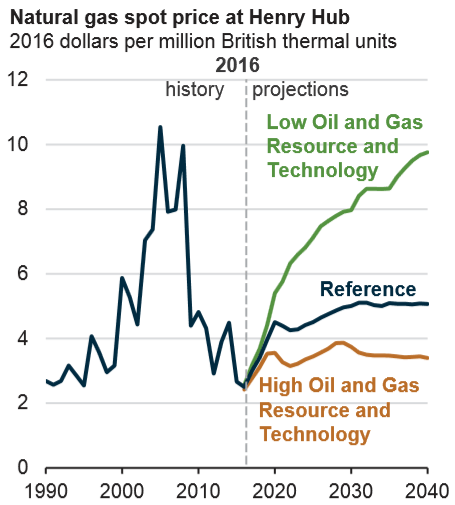
Therefore, from our selected portfolio of renewables we see that the potential exist to avoid approximately 5,300,000 MMBTU of natural gas annually. However, this does not come cheap as total investment cost estimates to US $640 million. The chart to the left shows the projected price of natural gas up to 2040.
If we therefore look at the pessimistic case, we see that the price of natural gas in the US is projected to vary between US $3.00 to $4.00 over the remaining period and averages about US $3.50. Using this price we estimate a potential earning of US $18.6 million annually. The optimistic outlook, on the other hand, shows an average price of approximately US $6.80 resulting in a potential earning of US $36 million per annum.
Both the pessimistic and the optimistic outlooks gave very large negative net present values using a 10% discount rate over a 20 year period. The optimistic case only gave a positive net present value for a discount rate of about 1%. The analysis assumes that the projects would be government owned and did not take into consideration the operation and maintenance cost over the life of the project. Overall, it shows that the projected revenues to be derived from the sale of the avoided natural gas on the open market will not return the capital invested over a 20 year horizon.
 xenogyre.com