Category: Hydro Energy

  • Jamaica’s RE Near Term Outlook

    Jamaica’s RE Near Term Outlook

    The Jamaican electricity sector has seen its fair share of investment in renewable energy over the last two decades or so, to the tune of approximately US$360 million to be exact.

    Development to date:

    Jamaica has a long history of using its indigenous renewable sources of energy to generate electricity. This dates back as far as 1955 when the Upper White River hydroelectric power plant was inaugurated. The recent thrust to incorporate other forms of indigenous renewable sources of energy into the country’s energy mix started with the installation of a 225 kW wind turbine in 1996 at the Munro College campus, in St. Elizabeth, some fifty years later.

    The success of the Munro installation led to the development of the country’s first commercial wind farm in 2004, the 20.7 MW Wigton I plant located in the neighbouring parish of Manchester. The plant had its fair share of issues, ranging from technical to financial, but the experience gained led to an 18 MW expansion in 2010, dubbed as Wigton II. In 2010 the utility company, the Jamaica Public Service (JPS) Company, also completed its first wind farm, a 3 MW plant located in close proximity to the Munro campus.

    The publishing of the country’s national energy policy in 2009 and it’s draft renewable energy policy in 2010 prompted the development of several renewable energy projects. The first was a 7.2 MW expansion of JPS’s Maggotty hydroelectric plant in 2014. Then in 2016, the country witnessed the largest commissioning of renewable energy plants in a single year, closing out the year with a whopping total of 80 MW. This consisted of the 24 MW expansion of the Wigton Wind Farm (Wigton III), the 36 MW privately owned Wind Farm in St. Elizabeth, and the 20 MW Solar Farm in Clarendon, also privately owned.

    A near term outlook:

    The next renewable energy project on the horizon is the 33.1 MW Eight Rivers Solar Farm in Paradise Park, Westmoreland. In 2015, this project was selected by the Office of Utilities Regulation (OUR) from a list of 19 bids, received in response to a request for proposal (RFP) for renewable energy with capacity up to 37 MW. The privately-owned solar farm broke ground last month and is expected to be completed by December 2018 at an estimated cost of US$48.7 million dollars.

    Once completed this solar farm will be the second, but largest, solar installation on the island and it will feed electricity into the JPS grid at US$0.0854 per kWh. At this feed in rate, which is less than half that of the other solar farm on the island, this project has proven that renewable energy projects can rival conventional generation and it sets a new price ceiling for future renewable energy projects in Jamaica.

    Though the potential for wind energy on the island has not yet been exhausted, the Petroleum Corporation of Jamaica (PCJ), the parent company of Wigton Windfarms Ltd, is seeking to quantify the country’s offshore wind potential. The PCJ applied for and was awarded, in October of last year, a grant from the United States Trade and Development Agency (USTDA) to undertake a feasibility study of the island’s offshore wind potential. Preliminary work should have started during the final quarter of 2017 and the study is scheduled to last for 12 months. Should it proves feasible and leads to the development of viable offshore wind farms; it will be another first for Jamaica and the wider Caribbean.

    Grid storage is also on the horizon if JPS is successful in obtaining the necessary approvals from the OUR. In May of last year, JPS sent out an RFP for the supply and installation of a 13 or 24.5 MW hybrid energy storage system. According to the light and power company, this system is required to smooth the effect of the intermittent renewable energy sources presently on the grid and also to provide other essential grid services such as frequency support, voltage support, and spinning reserve.

    Dubbed as a first of its kind in the Caribbean, this energy storage system will utilize a combination of high-speed and low-speed flywheels and containerized lithium-ion batteries and is to be located at the Hunts Bay Power Plant substation. Once approved by the regulator, it is expected to be completed by the third quarter of 2018 at an estimated cost of US$21 million.

    The Government is currently putting together an Integrated Resource Plan (IRP) with the intent to guide the development of a modern energy sector in Jamaica. The IRP is expected to establish the projected electricity demand over the next 20 year period, determine the generation capacity and technologies to be used to satisfy this demand, and to establish agreements on the transmission and distribution infrastructure to generate and deliver the needed electricity and the resulting tariffs.

    The IRP, which was originally slated for completion late last year, when completed will give all stakeholders, including the investment community, a clear view of the agreed suite of medium to long term investment opportunities necessary to achieve the island’s 2030 renewable energy target of 30%.

  • Jamaica’s Hydroelectric Potential

    Jamaica’s Hydroelectric Potential

    Jamaica, the paradise island that is sometimes referred to as  “the land of wood and water,” has great hydroelectric potential due primarily to its many rivers, land topography and climate. Out of a list of 120 rivers, the Island has several rivers that are suitable for hydroelectric power generation.

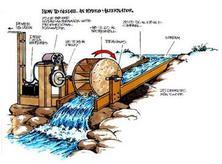
    run-of-river hydroelectric plan
    run-of-river hydroelectric plan

    Hydroelectric power is power generated from water. A basic hydroelectric power plant generates electricity in a three-stage process: First, water wheels are used to capture the kinetic energy (energy of motion) from falling or running water. Next, this kinetic energy is converted into mechanical energy by a gear mechanism attached to the water wheel. Then finally, the mechanical energy is converted into electrical energy by an alternator that is connected to the gear mechanism.

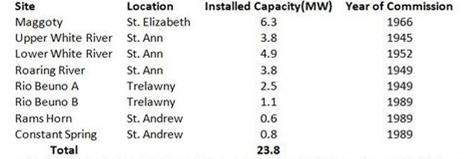
    For over 100 years Jamaica has been exploiting its hydroelectric potential through the use of “run-of-river” hydroelectric power plants. There are currently eight (8) such plants in operation across the island today:

    These plants are owned and maintained by Jamaica Public Service Company (JPSCo.). Together they produce approximately 5% baseload capacity for the public electricity grid during the rainy seasons. Most of these systems are fairly old, however, with the youngest ones being more than 15 years old. These eight hydroelectric power stations save the country roughly US$27M on fuel imports annually. The following chart shows historical data of hydroelectric power generation in Jamaica:

    In April 2011, the JPSCo unveiled plans to undertake the first major hydroelectric development in Jamaica in 30 years. This involves the commissioning of a new plant that will further reduce the country’s oil import by 48,000 barrels of fuel per year. At an estimated price of $100 per barrel, this would save Jamaica US$4.8M annually. The new plant, which will see the doubling of the capacity at the Magotty Hydroelectric Plant, is scheduled for completion by July 2013.

    The Petroleum Corporation of Jamaica (PCJ) has shown through studies that Jamaica’s hydroelectric potential could be further exploited through the construction of a number of small-scale plants. The total technical potential is estimated to be in the range of more than 56 MW, including one large-scale facility at Back Rio Grande, as shown below.
    While the technical feasibility was proven in most cases, the economic assessment resulted in negative decisions in the past due to the high investment costs involved and comparatively low electricity generation costs from conventional plants. However, with the hike in oil prices (currently at US$99.87 per barrel) resulting in an increase in electricity generation costs, this picture is changing as can be seen from JPS’s recent decision to expand the capacity of the Maggoty Plant.

    Currently, the PCJ’s Centre of Excellence for Renewable Energy (CERE) division that has been mandated to support the implementation of new ideas and methods in renewable energy in Jamaica is pursuing several hydroelectric initiatives. The CERE has partnered with two international companies to update the technical, financial and economic feasibility study on five potential hydroelectric projects (listed below). CERE has partnered with BPR’s Power Division in four of the five projects and IT Power Ltd. in the other. BPR is a private engineering consulting firm located in Quebec, Canada, and IT Power Ltd. is a climate change consulting firm located in the United Kingdom.

    1. The Back Rio Grande Hydropower Plant: Back Rio Grande is located in the parish of Portland at the north eastern end of the island.

    Project Highlights – Back Rio Grande Potentials:

    • 6 MW of electricity potential
    • 17,120 MWh of electricity per year
    • 10,000 barrels of avoided oil imports
    • 14,000 tonnes of CO2 emission reductions
    • Foreign Direct Investment US$20.7 million

    2. The Great River Hydropower plant: Great River borders the parishes of St. James and Hanover, on the north western coast of the island.

    Project Highlights – Great River Potentials:

    • 8 MW of electricity potential
    • 35,218 MWh of electricity per year
    • 21,000 barrels of avoided oil imports
    • 29,000 tonnes of CO2 emission reductions
    • Foreign Direct Investment US$23.6 million

    3. The Laughlands Hydropower Plant: Laughlands Great River, a Greenfield site, is located in the parish of St. Ann, on the north coast of the island.

    Project Highlights – Laughland Potentials:

    • 2 MW of electricity potential
    • 13,920 MWh of electricity per year
    • 8,000 barrels of avoided oil imports
    • 12,000 tonnes of CO2 emission reductions
    • Foreign Direct Investment US$6.7 million

    4. The Rio Grande (1 & 2) Hydropower Plants: Rio Grande is located in the parish of Portland at the north eastern end of the island.

    Project Highlights – Rio Grande Potentials

    • 2 MW of electricity potential
    • 8,425 MWh of electricity per year
    • 5,000 barrels of avoided oil imports
    • 7,000 tonnes of CO2 emission reductions
    • Foreign Direct Investment US$6.8 million

    5. The Swift River Hydropower Plant: Swift River is a tributary of the Rio Grande, located in the parish of Portland at the north eastern end of the island.

    Project Highlights – Swift River Potentials

    • 2 MW of electricity potential
    • 8,390 MWh of electricity per year
    • 4,900 barrels of avoided oil imports
    • 6,900 tonnes of CO2 emission reductions
    • Foreign Direct Investment US$6.5 million

    These feasibility studies now open up the door for members of the private sector to step in and play a bigger role in leading the way forward towards the uses of cleaner, and cheaper sources of electricity. Private investors should, however, be aware that current legislation requires a license for all types of water uses, issued by the Water Resources Authority. The license is granted for a period of 5 years but can be extended thereafter. In competing situations, preference is given to fresh-water use over any energetic purposes. All environmental aspects have to be approved by the National Environment Protection Agency (NEPA).