Tag: Wind Turbines

  • Electricity from the Wind – Part 1

    Electricity from the Wind – Part 1

    Wind as a source of electric energy in the Caribbean is now becoming commonplace, with utility-scale wind power plants in operation on Aruba, Bonaire, Curacao, Cuba, Dominican Republic, Guadeloupe, Jamaica, Nevis, Puerto Rico, and Martinique. Barbados, Guyana, and St. Lucia are next in line to add utility-scale wind energy to their energy mix.

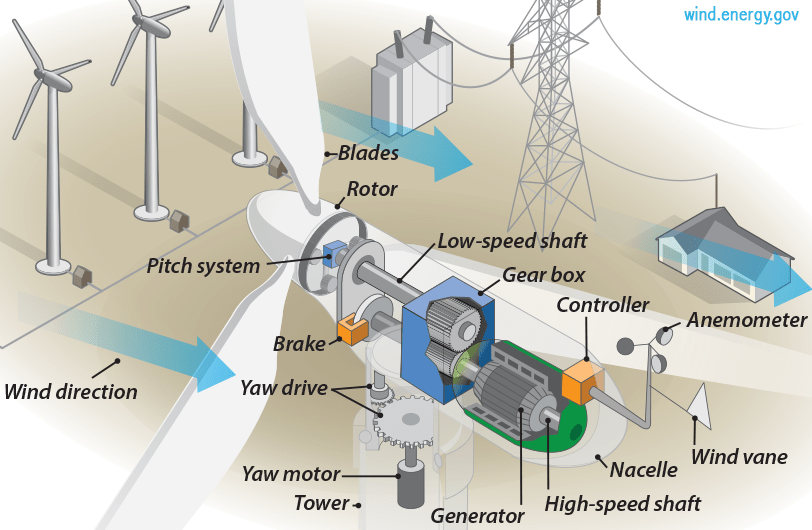
    Utility-scale wind power plants consist of several wind turbines, most of which are usually connected to each other in a daisy-chained fashion. The turbine, which is the heart of the plant, converts the kinetic energy of wind into electricity. A modern wind turbine consists of a three-blade rotor that captures the energy from the wind and drives a generator to produce electricity. The rotor and the nacelle, which contained the electric generator and the other necessary parts, are installed at the top of a tower, as shown below. The nacelle and the blades are controlled based on measurements of the wind speed and direction.
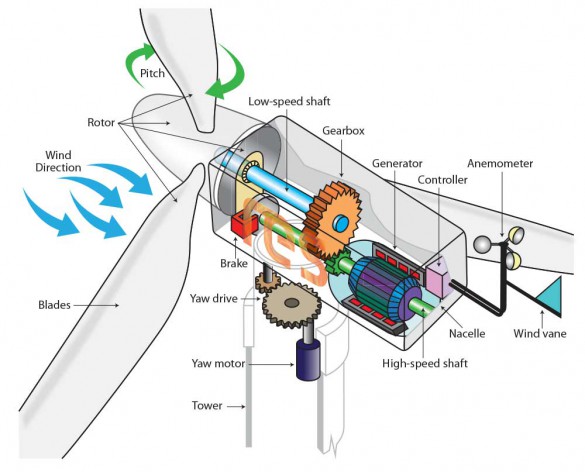
    parts of a wind turbine

    The amount of power that a wind turbine can extract from the wind is primarily dependent on the rotor swept area (A) and the wind speed (U). Therefore, to extract maximum energy from the wind, turbine manufacturers have been increasing the rotor diameter of their wind turbines over the decades, as shown below. Likewise, wind farm developers are always scouting for areas across the globe with high and stable wind speed all year round to develop economically competitive wind projects.

    wind turbine growth over the decades

    The actual power output of a wind turbine is limited by physical restrictions and is best illustrated by its power curve. The power curve of a wind turbine shows the electrical power output of the wind turbine versus the wind speed. An example of a power curve is shown below. It represents a Vestas V112-3.3 wind turbine as used in the case of the BMR wind farm in Jamaica. It has a rotor diameter of 112 meters and a rated/nominal power of 3.3 MW.
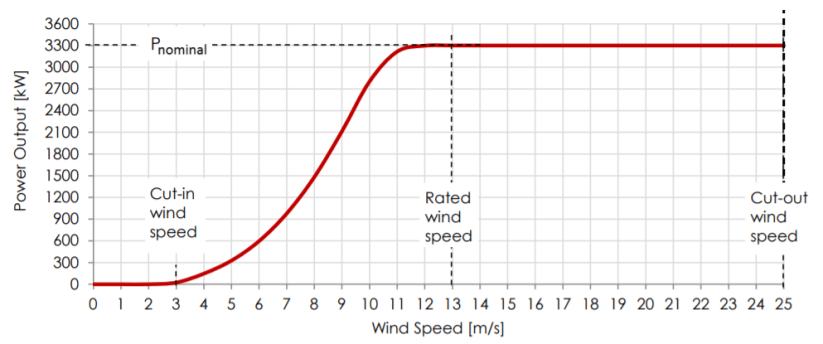
    V112-3.3 Power Curve

    The operating range of the wind turbine is defined by the cut-in and cut-out wind speeds. At the cut-in wind speed, typically around 3 m/s, the turbine starts to operate and produce electric energy. The cut-out wind speed, 25 m/s in the case of the V112-3.3 turbine, demarcates the upper safe operating wind speed at which point the turbine will stop producing electric energy and shut itself down. The rated wind speed is the wind speed at which the turbine produces its rated power output. The rated power of the V112-3.3 turbine is reached at 13 m/s.

    If this wind turbine was to operate at rated power for one hour it would produce 3.3 MWh (3,300 kWh). This is approximately 150% of the annual energy consumption of the average family home in Jamaica. However, wind turbines don’t always operate at their rated power output, due to the variability of the wind speed. Therefore, a measure known as capacity factor, is typically used to assess the efficiency of a turbine or wind farm. It is defined as the average power output of a wind turbine/farm as a percentage of the rated power of the turbine/wind farm.

    For most wind turbines erected on land, the capacity factor is between 20-40% or expressed in full-load hours it is around 1,800-3,500 hours per annum. The capacity factor for the Wigton and BMR wind farms in Jamaica are shown in the following table along with their rated power and estimated annual energy production based on their capacity factors.

    Wind Farm Capacity (MW)Capacity Factor (%)Annual Energy (MWh)
    Wigton I20.73563,466.20
    Wigton II183352,034.40
    Wigton III243063,072.00
    BMR36.334108,115.92
    Munro34010,512.00
    Total 10232286,688.52
    Capacity Factor for wind farms in Jamaica

    From the total install capacity of 102 MW and the total estimated annual energy of 286,688,52 MWh, an overall capacity factor of 32% is estimated.

    In part 2, we will look at turbine design parameters for specific wind sites.
  • Wind Turbines – I’m a Big Fan!

    Wind Turbines – I’m a Big Fan!

    The Wind Turbine is Renewable Energy biggest fan and I am a fan of wind turbines! Now since we are on the topic of fans, I decided to share with you the answer to a burning question I had some time ago regarding wind turbines. My mind boggling question was, “why don’t the turbines behave like a big fan when the wind stops?”

    And rather than simply turning to Google for the answer, I decided to ask the professionals and so I cold called Wigton Windfarm Limited instead. Unfortunately, there weren’t any Engineers available to tend to my question so I was put onto the project manager. It took few emails back and forth, but in the end, the simple answer was: at low wind speeds (or no wind condition) the wind generators are disconnected from the grid so as to prevent them from behaving like Big Fans.

    And here is the more detailed explanation: the Wigton wind farm consists of three separate installations namely, Wigton I, II and III. Wigton I, for example, consist of 23 NEG Micon NM52 – 900 kW wind turbines to give a total capacity of 20.7 MW. The electric generators are asynchronous (induction) generators. Therefore the rotor must turn faster than the synchronous speed of the electricity grid to generate power for the grid. Otherwise, if connected, it will consume power from the grid and in turn, operates like a Big Fan.

    The following diagram shows how power is generated by these massive turbines and is routed to the public electricity grid:

    image002

    The NEG Micon NM52 – 900 kW wind turbine contains 2 generators (double speed), as shown, based on an old Dutch manufacturing principle. The basis of which, is to optimize power generated at both low and high wind speeds. The small generator (g) generates power in the range 0 – 200 kW, while the large (G) generator generates power in the range 200 – 900 kW.

    When the wind speed is such that the turbine-generator reaches the number of revolutions needed to generate electric power a thyristor-based circuit breaker connects the generator to the electricity grid in a fashion known as soft connection. The thyristors are bypassed by mechanical switches if more than 50 kW of power is generated to avoid excessive stress on the thyristors. 

    The two generators cannot be connected at the same time. This is because the large generator is a 4-pole generator which must run at just over 1500 rpm (the synchronous rotational speed for a 4-pole machine). The small generator is a 6-pole generator which must run at just over 1000 rpm (the synchronous rotational speed for a 6-pole machine).

    At low wind speeds, i.e under 8 m/sec, the wind turbine starts up on the small generator. If the wind now freshens, it automatically connects to the large generator by disconnecting from the small one, “speeding up” and connecting to the large generator.

    Conversely, if the wind has been strong for a long time and suddenly drops, it is no longer worthwhile running on the large generator, and therefore the small generator is reconnected by folding out the blade tips and applying the rotor brake. Once revolutions have been reduced to a suitable level for the small generator, the process of connecting the small generator is started.

    These wind turbines do not always start up on the small generator. If the wind speed is 8-9 m/sec, as measured by an anemometer, the wind turbine will start up directly on the large generator completely by-passing the small one.

    So there you go….! No power is generated to the electricity grid until the generator is forced by the wind to run faster than its synchronous rotational speed, i.e. the rotor will run a little faster than the rotating magnetic field in the stator. And if the generator was already connected and wind stops or the drops below the cut-in speed of the turbine, the generator is disconnected from the grid.

    Thanks again to Wigton Windfarm Limited for taking the time to answer my question and to provide the technical details about the operating principle of their NEG Micon wind turbines…. I hope this helps if you have the same “stupid question (for an electrical engineer)” that I had the heart to ask!


  • The Economics of Wind Power in Jamaica

    The Economics of Wind Power in Jamaica

    In late 2013, the Office of Utilities Regulation (OUR) named three preferred bidders for the supply of up to 115 MW (megawatts) of electricity generation capacity from renewable energy. The three preferred bids amounted to a total 78 MW of energy only renewable energy capacity, including two projects offering energy from wind amounting to 58 MW, and one offering solar amounting to 20 MW. The proposed delivery price to the grid ranged from US$0.1290 to US$0.1880.

    The preferred bidders were:

    1. Blue Mountain Renewables LLC, to supply 34 MW of capacity from wind power at Munro, St. Elizabeth;

    2. Wigton Windfarm Limited, to supply 24 MW of capacity from wind power at Rose Hill, Manchester; and

    3. WRB Enterprises Inc., to supply 20 MW of capacity from Solar PV from facilities in Content Village, Clarendon.

    The 20 MW solar farm will be the first of its kind in the Island, however Jamaica’s first grid-connected wind-powered generator was commissioned in February 1996 at Munro College. This wind turbine-generator, a Vestas V27 – 225 kW, was also the first grid-connected wind-energy source in the English-speaking Caribbean. The project was funded primarily by the Environmental Foundation of Jamaica (EFJ), but also included a long list of local companies and individuals. The total installation cost of the facility was US$300,000. However, much of the local services, such as JPSCo’s services and Alpart’s crane services, were donated free of cost.

    The overwhelming success of the the Munro College wind turbine encouraged the Petroleum Corporation and the Government of Jamaica to commission Jamaica’s first large scale wind farm at Wigton (in the parish of Manchester) in 2004. The initial 20.7 MW wind farm, which came to be known as Wigton I, comprises of twenty three (23) NEG Micon NM52 – 900 kW wind turbines. The project was financed at a total cost of US$26.2 million with equity injection of US$ 3.2 million from the Petroleum Corporation of Jamaica (PCJ), a US$ 16 million loan from the National Commercial Bank of Jamaica (NCB) and a grant of US$ 7.0 million from the Netherlands Government.

    A midst several changes, including $150 million in lost revenues due to unfavorable energy rates and $120 million due to penalties imposed by JPS for reactive power demand and a fail divestment attempt in early 2007, the Wigton wind farm was expanded during the period 2009 to 2010 to include nine (9) Vestas V80 -2.0 MW wind turbines. The 18 MW project, now called Wigton II, was financed from the PetroCaribe Development Fund at total cost of US$49.9 million.

    In late 2010, JPS (the owner and operator) commissioned its first wind project – a 3 MW wind farm at Munro, St. Elizabeth. This project comprises of four (4) UNISON U50 – 750 kW wind turbines and was completed at a total cost of US$9.3 million.  The Munro wind farm interconnects to JPS 24kV distribution system unlike the Wigton wind farms, which interconnects to JPS 69kV system via a 11km long tie-line. It is worthwhile noting that the grid interconnection cost can account for as much as 8-9% of the total project cost. In the case of the Wigton wind farms the 11kM 69kV line was included in the capital cost of the initial project.

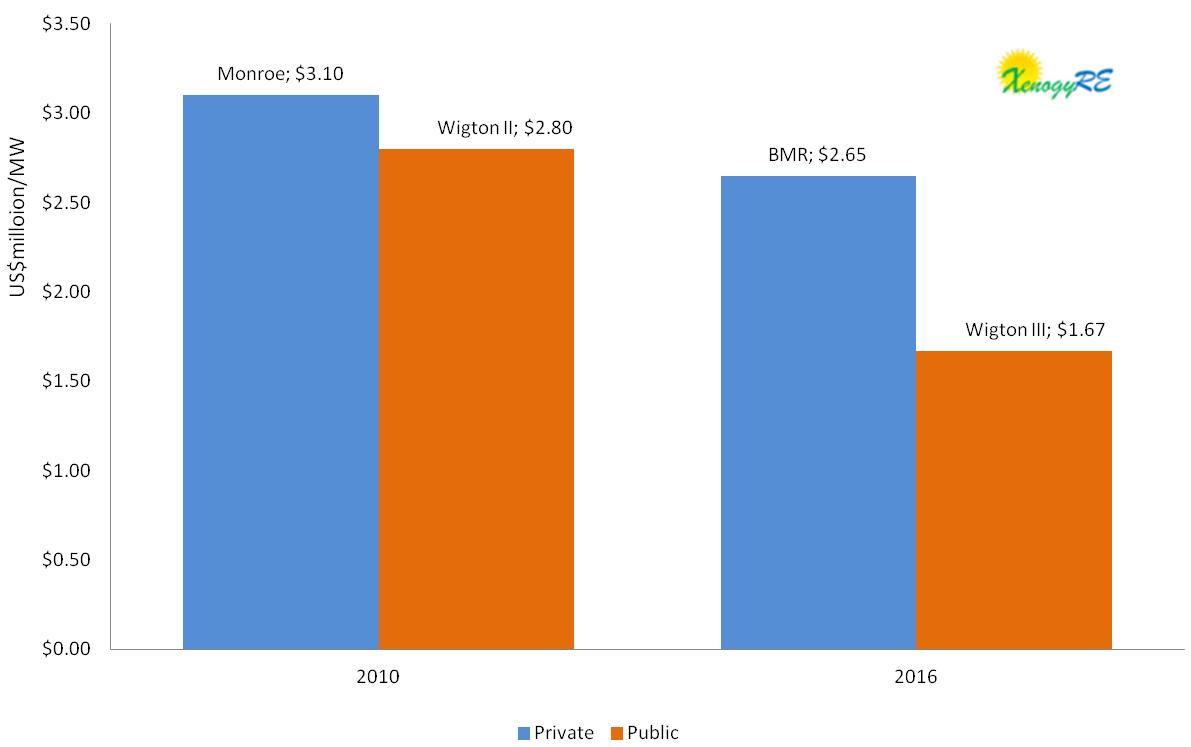
    The two new wind farms coming out of the OUR latest request for renewable energy in addition to the national grid are projected to cost US$40 million for the WWF’s (Wigton Windfarm) 24 MW wind farm and US$90 million for the BMR’s (Blue Mountain Renewables) 34 MW wind farm. The cost of these two project forces me to ask one key question “how does public vs private investor wind power projects costs compare?”. I thought that a good way to get a fair comparison was to look at the projects that had/have  the same/similar time horizon. So, I decided to firstly compare the Wigton II and JPS Munro wind farm projects (which were both commissioned in 2010) and secondly the proposed Wigton III and BMR Munro wind farm projects (both scheduled to be commission in 2016), as shown below.

    privatevspublic

    This comparison revealed two important facts:

    1. Private investor wind projects in Jamaica cost more than public wind projects. In the first case, the JPS Munro wind farm cost approximately 1.1 times the cost of the Wigton II wind farm on a per megawatt basis. Similarly, the proposed BMR Munro wind farm will cost approximately 1.6 times the proposed Wigton III wind farm on a per megawatt basis. It would be good to see a breakdown of the project cost to see exactly where the projects varied in term of cost.

    2. The cost of wind power has come down by 40% for public projects and 15% for private projects since 2009.

    Wind Capital Cost StructureThe cost of a wind project has a lot to do with its total size (economics of scale) however the most common way to compare wind project cost is on a per megawatt basis, as was done here. It is also worthwhile to add that the basic cost components of  wind projects typically include: turbine cost, grid interconnection, foundation, electrical installation, consultancy, financial cost, road construction, control systems, etc. The inserted table gives a break down of the % share of the total cost for each component.

    Public projects, in most cases, could have a competitive advantage in terms of the land rental, financial cost and road construction components which could possibly explain to some extent why public projects have been carrying lower project cost compared to the few private projects that we have seen in Jamaica’s recent renewable energy history.