
Tag: Grid Integration

  • Barbados’ First Utility-Scale Solar PV Farm

    Barbados’ First Utility-Scale Solar PV Farm

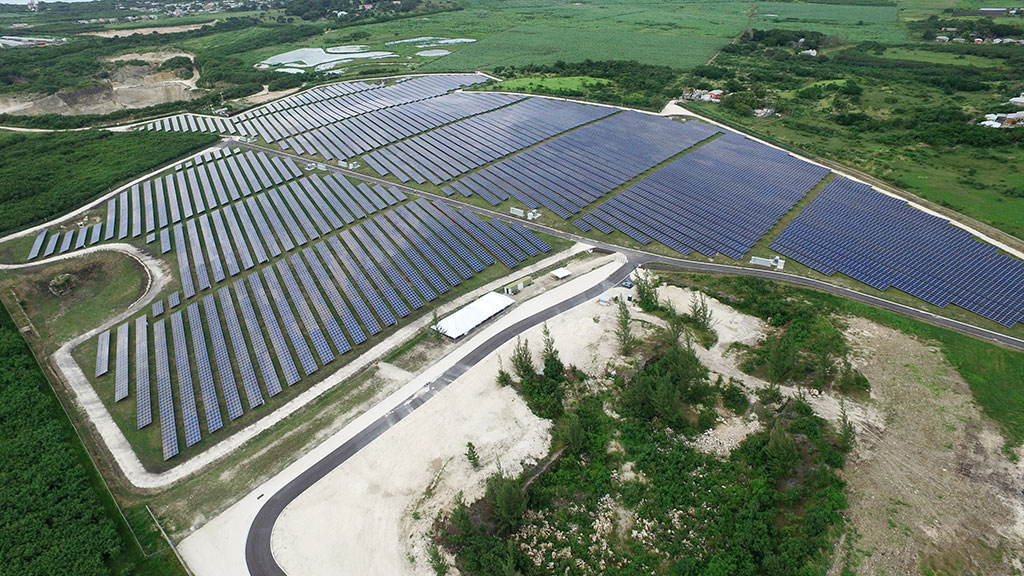
    The Barbados Light & Power (PL&P) 10 MW solar PV farm in Trents, St. Lucy is the Island’s first utility-scale solar project.

    In 2014, the light and power company invited proposals for a solar photovoltaic system of up to 8 megawatts (MW) on an engineering, procurement and construction turnkey basis, for which over 40 bids were received. However, the proposal by the Spanish firm, Grupotec, to construct a 10 MW (AC) solar on the over 40 acres of land identified by BL&P was selected as the preferred bid.

    The project, which consists of approximately 44,500 solar panels, broke ground in January 2016, having signed the EPC contract in late 2015. The plant was officially put into commercial operation in August of 2016, following 8 months of construction and commissioning activities. Also as part of the project, a new substation was also constructed onsite to interconnect the solar facility to the national grid. The project cost a total of approximately US $20 million.

    trent solar barbados.png

    The facility has been in service now for more than two years and it has been reported to be performing as expected. It has been estimated to be delivering fuel savings of approximately  US $4.5 million per year.

    Since its completion, BL&P announced plans for another solar farm at Lower Estate in St George and is working to make the 10 MW wind farm at Lamberts in St. Lucy a reality, so as to increase its portfolio of utility-scale renewable energy generation.

    In addition, the light and power company has a renewable energy rider (RER) program that facilitates the integration of distributed solar and wind energy sources, of sizes up to 500 kilowatts (kW). The program to date has amassed a total of over 12 MW of renewable energy capacity, since first piloted in 2010.

    Furthermore, the Government of Barbados is endeavouring to supply 100% of the island’s electricity needs from renewable energy sources by 2030. This forms the basis for the recent enactment of a new Electricity Light and Power Act, in 2013. The new Act opened up the electricity generation market to independent power producers (IPPs), who can now develop utility-scale renewable energy projects and supply energy to BL&P. The act allows for up 20 MW solar and 15 MW of wind to be added by IPP’s.

    So while the 10 MW solar farm in Trent, St. Lucy marks the Country’s first utility-scale project, the stage is now set for a lot more to follow.
  • Wind Turbines – I’m a Big Fan!

    Wind Turbines – I’m a Big Fan!

    The Wind Turbine is Renewable Energy biggest fan and I am a fan of wind turbines! Now since we are on the topic of fans, I decided to share with you the answer to a burning question I had some time ago regarding wind turbines. My mind boggling question was, “why don’t the turbines behave like a big fan when the wind stops?”

    And rather than simply turning to Google for the answer, I decided to ask the professionals and so I cold called Wigton Windfarm Limited instead. Unfortunately, there weren’t any Engineers available to tend to my question so I was put onto the project manager. It took few emails back and forth, but in the end, the simple answer was: at low wind speeds (or no wind condition) the wind generators are disconnected from the grid so as to prevent them from behaving like Big Fans.

    And here is the more detailed explanation: the Wigton wind farm consists of three separate installations namely, Wigton I, II and III. Wigton I, for example, consist of 23 NEG Micon NM52 – 900 kW wind turbines to give a total capacity of 20.7 MW. The electric generators are asynchronous (induction) generators. Therefore the rotor must turn faster than the synchronous speed of the electricity grid to generate power for the grid. Otherwise, if connected, it will consume power from the grid and in turn, operates like a Big Fan.

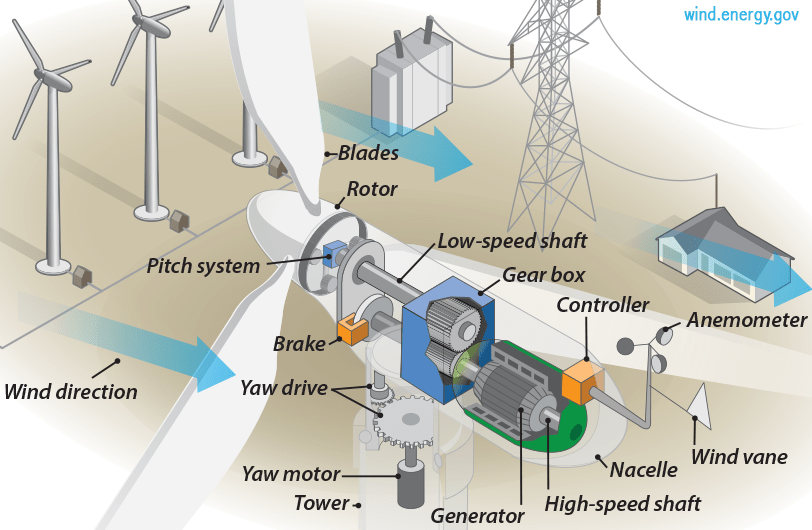
    The following diagram shows how power is generated by these massive turbines and is routed to the public electricity grid:

    image002

    The NEG Micon NM52 – 900 kW wind turbine contains 2 generators (double speed), as shown, based on an old Dutch manufacturing principle. The basis of which, is to optimize power generated at both low and high wind speeds. The small generator (g) generates power in the range 0 – 200 kW, while the large (G) generator generates power in the range 200 – 900 kW.

    When the wind speed is such that the turbine-generator reaches the number of revolutions needed to generate electric power a thyristor-based circuit breaker connects the generator to the electricity grid in a fashion known as soft connection. The thyristors are bypassed by mechanical switches if more than 50 kW of power is generated to avoid excessive stress on the thyristors. 

    The two generators cannot be connected at the same time. This is because the large generator is a 4-pole generator which must run at just over 1500 rpm (the synchronous rotational speed for a 4-pole machine). The small generator is a 6-pole generator which must run at just over 1000 rpm (the synchronous rotational speed for a 6-pole machine).

    At low wind speeds, i.e under 8 m/sec, the wind turbine starts up on the small generator. If the wind now freshens, it automatically connects to the large generator by disconnecting from the small one, “speeding up” and connecting to the large generator.

    Conversely, if the wind has been strong for a long time and suddenly drops, it is no longer worthwhile running on the large generator, and therefore the small generator is reconnected by folding out the blade tips and applying the rotor brake. Once revolutions have been reduced to a suitable level for the small generator, the process of connecting the small generator is started.

    These wind turbines do not always start up on the small generator. If the wind speed is 8-9 m/sec, as measured by an anemometer, the wind turbine will start up directly on the large generator completely by-passing the small one.

    So there you go….! No power is generated to the electricity grid until the generator is forced by the wind to run faster than its synchronous rotational speed, i.e. the rotor will run a little faster than the rotating magnetic field in the stator. And if the generator was already connected and wind stops or the drops below the cut-in speed of the turbine, the generator is disconnected from the grid.

    Thanks again to Wigton Windfarm Limited for taking the time to answer my question and to provide the technical details about the operating principle of their NEG Micon wind turbines…. I hope this helps if you have the same “stupid question (for an electrical engineer)” that I had the heart to ask!