
Tag: Barbados

  • Electricity from the Wind – Part 1

    Electricity from the Wind – Part 1

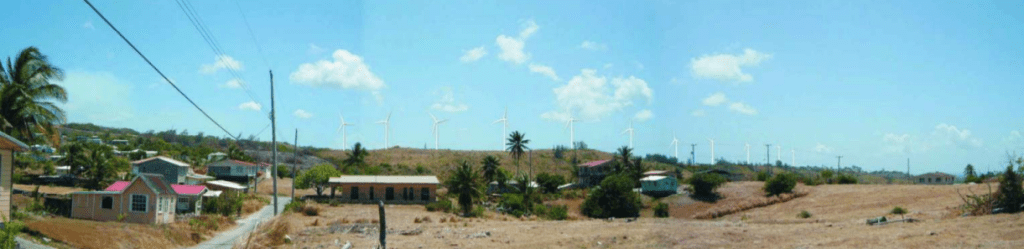
    Wind as a source of electric energy in the Caribbean is now becoming commonplace, with utility-scale wind power plants in operation on Aruba, Bonaire, Curacao, Cuba, Dominican Republic, Guadeloupe, Jamaica, Nevis, Puerto Rico, and Martinique. Barbados, Guyana, and St. Lucia are next in line to add utility-scale wind energy to their energy mix.

    Utility-scale wind power plants consist of several wind turbines, most of which are usually connected to each other in a daisy-chained fashion. The turbine, which is the heart of the plant, converts the kinetic energy of wind into electricity. A modern wind turbine consists of a three-blade rotor that captures the energy from the wind and drives a generator to produce electricity. The rotor and the nacelle, which contained the electric generator and the other necessary parts, are installed at the top of a tower, as shown below. The nacelle and the blades are controlled based on measurements of the wind speed and direction.
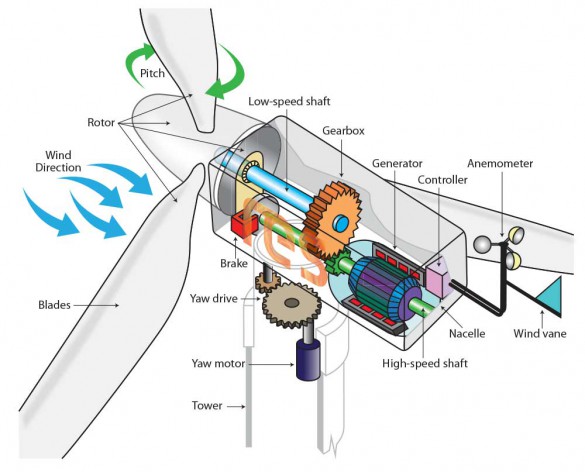
    parts of a wind turbine

    The amount of power that a wind turbine can extract from the wind is primarily dependent on the rotor swept area (A) and the wind speed (U). Therefore, to extract maximum energy from the wind, turbine manufacturers have been increasing the rotor diameter of their wind turbines over the decades, as shown below. Likewise, wind farm developers are always scouting for areas across the globe with high and stable wind speed all year round to develop economically competitive wind projects.

    wind turbine growth over the decades

    The actual power output of a wind turbine is limited by physical restrictions and is best illustrated by its power curve. The power curve of a wind turbine shows the electrical power output of the wind turbine versus the wind speed. An example of a power curve is shown below. It represents a Vestas V112-3.3 wind turbine as used in the case of the BMR wind farm in Jamaica. It has a rotor diameter of 112 meters and a rated/nominal power of 3.3 MW.
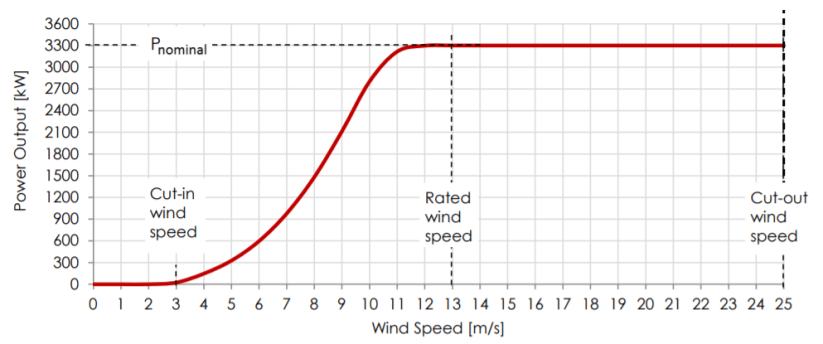
    V112-3.3 Power Curve

    The operating range of the wind turbine is defined by the cut-in and cut-out wind speeds. At the cut-in wind speed, typically around 3 m/s, the turbine starts to operate and produce electric energy. The cut-out wind speed, 25 m/s in the case of the V112-3.3 turbine, demarcates the upper safe operating wind speed at which point the turbine will stop producing electric energy and shut itself down. The rated wind speed is the wind speed at which the turbine produces its rated power output. The rated power of the V112-3.3 turbine is reached at 13 m/s.

    If this wind turbine was to operate at rated power for one hour it would produce 3.3 MWh (3,300 kWh). This is approximately 150% of the annual energy consumption of the average family home in Jamaica. However, wind turbines don’t always operate at their rated power output, due to the variability of the wind speed. Therefore, a measure known as capacity factor, is typically used to assess the efficiency of a turbine or wind farm. It is defined as the average power output of a wind turbine/farm as a percentage of the rated power of the turbine/wind farm.

    For most wind turbines erected on land, the capacity factor is between 20-40% or expressed in full-load hours it is around 1,800-3,500 hours per annum. The capacity factor for the Wigton and BMR wind farms in Jamaica are shown in the following table along with their rated power and estimated annual energy production based on their capacity factors.

    Wind Farm Capacity (MW)Capacity Factor (%)Annual Energy (MWh)
    Wigton I20.73563,466.20
    Wigton II183352,034.40
    Wigton III243063,072.00
    BMR36.334108,115.92
    Munro34010,512.00
    Total 10232286,688.52
    Capacity Factor for wind farms in Jamaica

    From the total install capacity of 102 MW and the total estimated annual energy of 286,688,52 MWh, an overall capacity factor of 32% is estimated.

    In part 2, we will look at turbine design parameters for specific wind sites.
  • Barbados’ First Utility-Scale Solar PV Farm

    Barbados’ First Utility-Scale Solar PV Farm

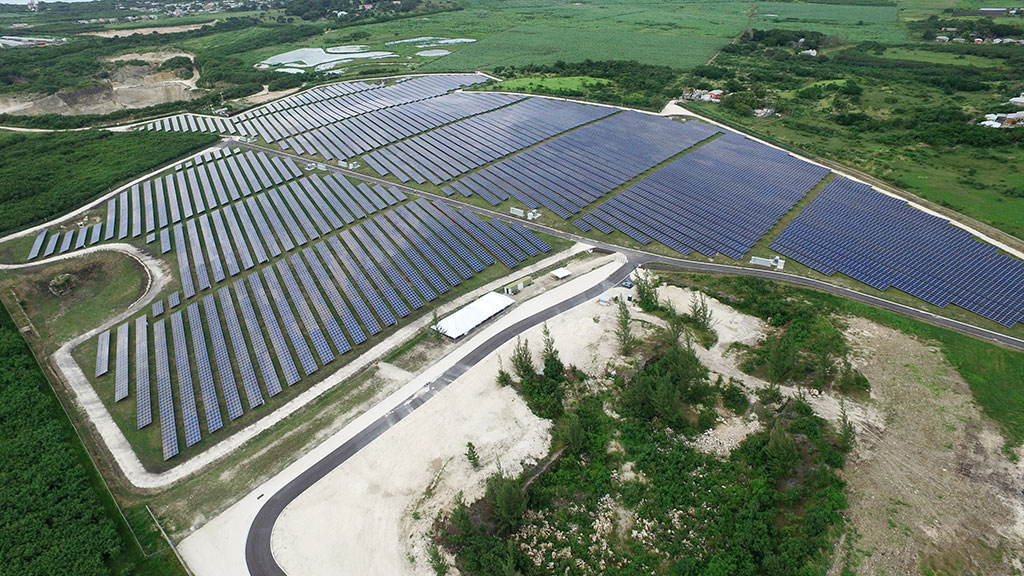
    The Barbados Light & Power (PL&P) 10 MW solar PV farm in Trents, St. Lucy is the Island’s first utility-scale solar project.

    In 2014, the light and power company invited proposals for a solar photovoltaic system of up to 8 megawatts (MW) on an engineering, procurement and construction turnkey basis, for which over 40 bids were received. However, the proposal by the Spanish firm, Grupotec, to construct a 10 MW (AC) solar on the over 40 acres of land identified by BL&P was selected as the preferred bid.

    The project, which consists of approximately 44,500 solar panels, broke ground in January 2016, having signed the EPC contract in late 2015. The plant was officially put into commercial operation in August of 2016, following 8 months of construction and commissioning activities. Also as part of the project, a new substation was also constructed onsite to interconnect the solar facility to the national grid. The project cost a total of approximately US $20 million.

    trent solar barbados.png

    The facility has been in service now for more than two years and it has been reported to be performing as expected. It has been estimated to be delivering fuel savings of approximately  US $4.5 million per year.

    Since its completion, BL&P announced plans for another solar farm at Lower Estate in St George and is working to make the 10 MW wind farm at Lamberts in St. Lucy a reality, so as to increase its portfolio of utility-scale renewable energy generation.

    In addition, the light and power company has a renewable energy rider (RER) program that facilitates the integration of distributed solar and wind energy sources, of sizes up to 500 kilowatts (kW). The program to date has amassed a total of over 12 MW of renewable energy capacity, since first piloted in 2010.

    Furthermore, the Government of Barbados is endeavouring to supply 100% of the island’s electricity needs from renewable energy sources by 2030. This forms the basis for the recent enactment of a new Electricity Light and Power Act, in 2013. The new Act opened up the electricity generation market to independent power producers (IPPs), who can now develop utility-scale renewable energy projects and supply energy to BL&P. The act allows for up 20 MW solar and 15 MW of wind to be added by IPP’s.

    So while the 10 MW solar farm in Trent, St. Lucy marks the Country’s first utility-scale project, the stage is now set for a lot more to follow.

  • Make ‘Electricity’ while the Sun Shines

    Make ‘Electricity’ while the Sun Shines

    In a recent post, titled solar basis, I gave a quick overview on solar energy and its conversion into other, more useful, forms of energy (e.g. electricity). In this article however, I will delve a little into solar electric systems. But before I jump into it, I will briefly recap from that article what I think might be relevant here for those of you who did not read it as yet.

    Solar Thermal (left) and Solar Electric (right) (www.blog.thesietch.org)

    As outlined in the article, solar energy systems fall into two main categories: 1) solar thermal systems, which uses the thermal energy from the sun to heat a working fluid that in-turn can be used for heating and cooling in buildings (e.g. solar hot water heaters) or for electricity generation (e.g CSP’s) and 2) solar electric systems, which uses the concept of photoelectric to convert the light (irradiation) from the sun directly into electricity (e.g. photovoltaic cells). The later is of interest here and thus from here on out will be referred to as solar photovoltaic (PV) systems.

    The main components of a solar PV system is the PV Cells, which are grouped together to form a single PV Module. In solar installations several of these PV modules are typically connected (in series) to form an Array, as show in the diagram that follows.


    The PV cells themselves are semiconductor electronic devices that convert the sunlight directly into electricity and thus forms the heart of a solar PV power generation system. The modern form of the PV cell was invented in 1954 at Bell Telephone Laboratories.

    Currently, solar PV systems are one of the most “democratic” renewable technologies available. This is as a result of their modular size, which puts them within the reach of individuals and small-businesses who want to access their own power generation and lock-in electricity prices.

    Solar PV technology offers a number of significant benefits, including:

    • Solar power is a renewable resource that is available everywhere in the world.
    • Solar PV technologies are small and highly modular and can be used virtually anywhere, unlike many other electricity generation technologies.
    • Unlike conventional power plants using coal, nuclear, oil and gas; solar PV has no fuel costs and relatively low operation and maintenance (O&M) costs. PV can therefore offer a price hedge against volatile fossil fuel prices.
    • PV, although variable, has a high coincidence with peak electricity demand driven by cooling in summer and year round in hot countries.

    A wide range of PV cell technology is now available on the market, using different types of materials. PV cell technologies are usually classified into three generations, depending on the basic material used and the level of commercial maturity:

    • First-generation PV modules (fully commercial) uses a wafer-based crystalline silicon (c-Si) technology, either single crystalline (sc-Si) or multi-crystalline (mc-Si).
    • Second-generation PV systems (early market deployment) are based on thin-film PV technologies and generally include three main families: 1) amorphous silicon (a-Si) and micromorph silicon (a-Si/μc-Si); 2) Cadmium-Telluride (CdTe); and 3) Copper-Indium-Selenide (CIS) and Copper-Indium-Gallium-Diselenide (CIGS).
    • Third-generation PV systems include technologies, such as concentrating PV (CPV) and organic PV cells that are still under demonstration or have not yet been widely commercialised, as well as novel concepts under development.

    On average a PV cells life expectancy is 25 years and the cells are able to harness both direct and diffuse radiation from the sun. The amount of energy harnessed depends on the type of semiconductor material used in the solar cells, ambient operating temperature,  cloud cover, shading, tilt angle and the direction in which the PV modules are installed. As the earth rotates continuously, PV cells which have sun ‘tracking’ capability are able to harness more energy. Jamaica and Barbados is located 18 and 13 degrees north of the equator respectively, thus it is a recommended best practice to install PV modules facing south at an angle of 18 and 13 degrees respectively.

    Some simple questions to ask yourself before investing in Solar Energy:

    • How readily available is the natural resource – sunshine? How readily can you access it – shading etc?
    • Why are you interested in implementing a solar PV system – high cost of electricity or you are environmentally conscious?
    • What is the initial cost of implementing a solar PV system in your area – total cost and the cost of the individual components?
    • What is the maintenance requirements of your system of choice and estimated cost to maintain it?
    • Where can you install your PV system – on the roof or in your yard?
    • What is the warranty periods offered on PV modules, and other components of the system?
    • What are the impacts on the natural environment? Will it reduce your carbon footprint or contribute to other environmental issues?

    The answers to most of the questions are pretty much straight forward. My final line to you is that solar PV is one of the fastest growing renewable energy technologies today and it is expected that it will play a major role in future global electricity generation mix. So embrace your future today, by making steps to start generating your own electricity as the sun shines!

    feel free to register your comments below….

  • Energy Intensity Index

    Energy Intensity Index

    So what is Energy Intensity index exactly and why is it important? Energy intensity is a measure of energy conversion that is expressed as the amount of energy consumed per unit output. The energy intensity index (EII) is used to measure the efficiency of a country’s economy and is expressed as the ratio of a nation’s energy consumption to its GDP (gross domestic product). So why is GDP used? GDP is a popular index reflecting a country’s economy. It is easy to estimate and is readily available. Taking GDP as a measure of a country’s production output, it is easy to see that the energy intensity index could be used as a measure of a country’s efficiency from the view point of energy.

    A high energy intensity index in contrast to others indicates that a country consumes much more energy to generate one dollar of GDP, while a low energy intensity index indicates that a country consumes less to generate one dollar of GDP. A quick survey of the energy intensity index of a few Caribbean countries including Jamaica, Barbados, Dominican Republic, Haiti, Suriname, Guyana and oil rich Trinidad and Tobago revealed that Barbados led the pack having the lowest EII value of the seven countries surveyed, as shown below.

    It is no surprise that Barbados is leading the pack, due mainly to a shift from electric water heating to solar powered water heating. Jamaica, having done reasonably well at developing and integrating RE resources, hydro, wind, bio-fuel, into its energy mix, showed some improvement between 2006 to now.

    The EII value is one of many indices that is currently being used to track a country’s energy efficiency, and of all the measures that will contribute to meeting the challenge of sustainable development and limiting climate change, one obvious solution is to use energy more efficiently.