

Technology giant Apple Inc. has push the notch further with one of its later patent application, “ON-DEMAND GENERATION OF ELECTRICITY FROM STORED WIND ENERGY “. The intended objective of Apple’s proposal is to address the variability (more…)
Author: Courtney Powell
-
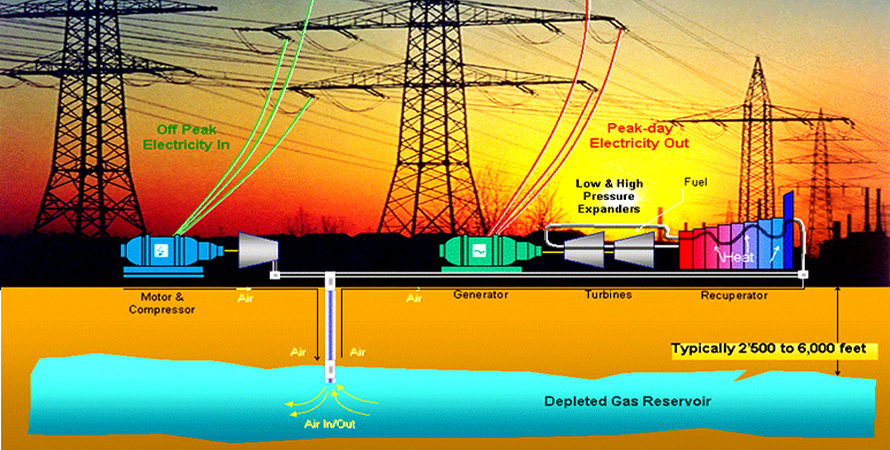
Compressed Air Energy Storage Technology
What is Compressed Air Energy Storage Technology? This is a form of large scale energy storage technology that is currently attracting the interest of technologists and researchers around the world. Called CAES (more…)
-
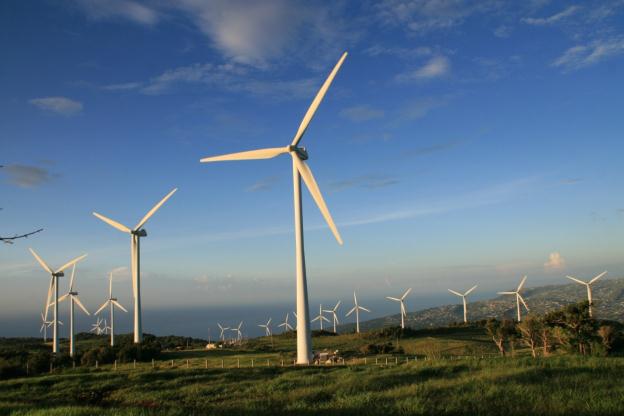
Jamaica Leads with 41.93 (MW)
Jamaica currently leads the Caribbean in wind energy integration, boasting an installed capacity of 41.93MW (Megawatts). Its latest addition to the national grid being the Munro Find Farm, completed in September 2010. (more…)
-

Energy Intensity Index
So what is Energy Intensity index exactly and why is it important? Energy intensity is a measure of energy conversion that is expressed as the amount of energy consumed per unit output. The energy intensity index (EII) is used to measure the efficiency of a country’s economy and is expressed as the ratio of a nation’s energy consumption to its GDP (gross domestic product). So why is GDP used? GDP is a popular index reflecting a country’s economy. It is easy to estimate and is readily available. Taking GDP as a measure of a country’s production output, it is easy to see that the energy intensity index could be used as a measure of a country’s efficiency from the view point of energy.
A high energy intensity index in contrast to others indicates that a country consumes much more energy to generate one dollar of GDP, while a low energy intensity index indicates that a country consumes less to generate one dollar of GDP. A quick survey of the energy intensity index of a few Caribbean countries including Jamaica, Barbados, Dominican Republic, Haiti, Suriname, Guyana and oil rich Trinidad and Tobago revealed that Barbados led the pack having the lowest EII value of the seven countries surveyed, as shown below.

It is no surprise that Barbados is leading the pack, due mainly to a shift from electric water heating to solar powered water heating. Jamaica, having done reasonably well at developing and integrating RE resources, hydro, wind, bio-fuel, into its energy mix, showed some improvement between 2006 to now.
The EII value is one of many indices that is currently being used to track a country’s energy efficiency, and of all the measures that will contribute to meeting the challenge of sustainable development and limiting climate change, one obvious solution is to use energy more efficiently.
-
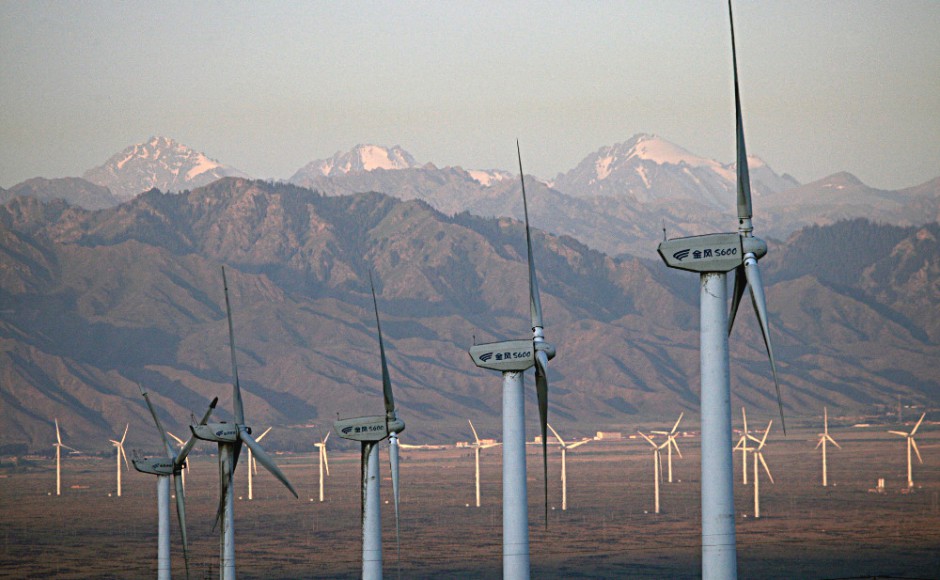
China Leads Growth in Global Wind Power Capacity
Global installed wind power capacity continued to grow in 2011, according to new research conducted by Worldwatch Institute Vital Signs Online service. The data collected showed that global wind power capacity topped out at 238,000 megawatts (MW) after adding just over 41,000 MW. This means that the global capacity grew by 21 percent in 2011, albeit lower than the 2010 rate of 24 percent and markedly lower than the 2009 rate of 31 percent. Nonetheless, the world now has four times as much installed wind power capacity than in 2005 (just seven years ago) reflecting the combined effects of falling prices, improved technology, global investment, and various incentive programs. China led the way with a 43 percent share of global capacity additions in 2011, followed by the United States at 17 percent, India with almost 7 percent, and Germany at 5 percent, writes report author and Climate and Energy Program Manager Mark Konold.
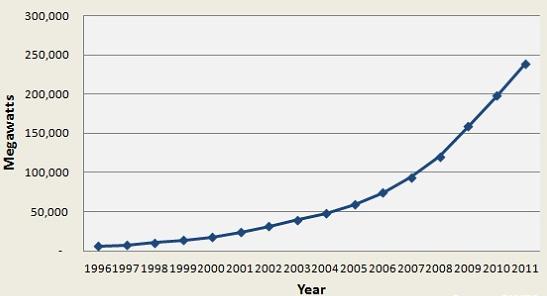
Total World Wind Energy Capacity, 1996-2011 In terms of cumulative capacity, China has a commanding 26 percent of global installed capacity. A total of almost $75 billion was invested in wind energy installations in 2011, which was 22 percent less than invested in 2010. For the second year in a row China set the pace and propped up the industry, increasing its total capacity by 40 percent over 2010 levels. China added just over 17,000 MW of new capacity, bringing its grand total to close to 63,000 MW. There remains an important gap between total installed capacity and actual electricity available for use from wind power, however. Despite having the most installed wind capacity, China still struggles to use all the electricity its turbines generate. read more at www.worldwatch.org
-
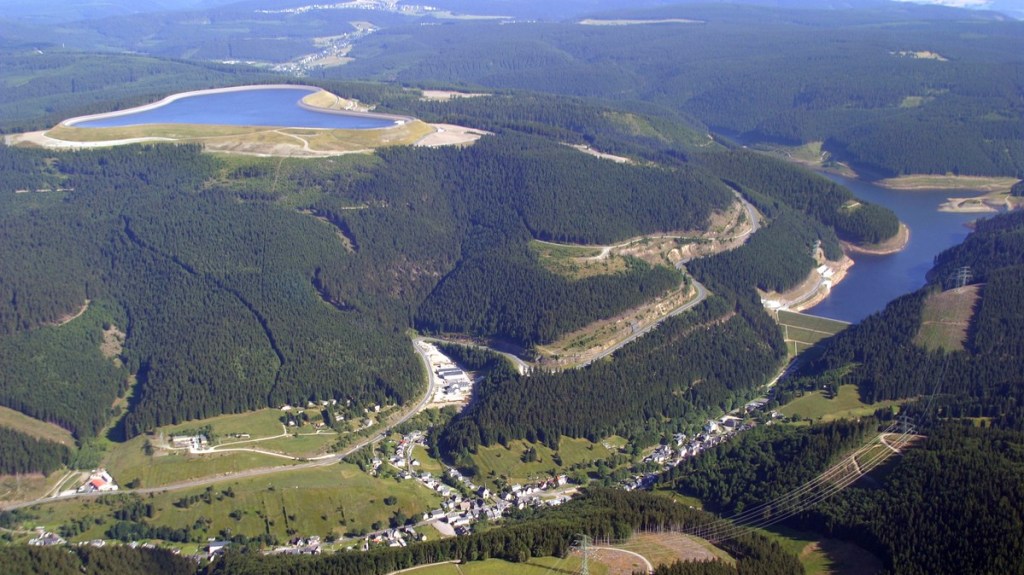
Pumped Hydroelectric Energy Storage Technology
Pumped Hydroelectric Energy Storage (PHES) is a form of energy storage technique that is based on the storage of a large amount of water at a high elevation. This is accomplished with two water reservoirs (artificial lake or sea) which are at two different elevations (pressure heads), by pumping water from the lower elevation to the higher elevation.
Water in the upper reservoir will be stored until it is needed, holding enough water for up to several days’ worth of electrical energy. When needed, the stored water is released from the upper reservoir and is used to drive hydro/water turbines, which intern drive electric generators to generate electricity.
The traditional application of PHES is arbitrage, where low-cost or off-peak electric power is used to run pumps, to pump the water from the lower reservoir to the upper reservoir and the stored water is released to produce electric power during periods of high electrical demand at which time the cost of electric energy is much higher.

Although the losses of the pumping process make the plant a net consumer of energy overall, the system increases revenue by selling more electricity during periods of peak demand, when electricity prices are highest. Pumped storage is the largest-capacity form of grid energy storage now available.
A more suitable application for this type of energy storage system is when it is used in conjunction with intermittent renewable energy resources such as wind and solar farms to optimize the availability of wind and solar power. See the article Grid level Energy Storage for more on large-scale energy storage systems.
-
Geothermal Potential in the Caribbean
As explained in the post geothermal energy is heat energy originating from beneath the earth’s crust. This heat is continually produced by the natural decay of radioactive materials such as uranium and potassium. According to the US Department of Energy, the amount of heat energy within 10,000 meters of the earth’s surface is 50,000 times more energy than the energy to be derived from all of the oil and natural gas resources in the world.
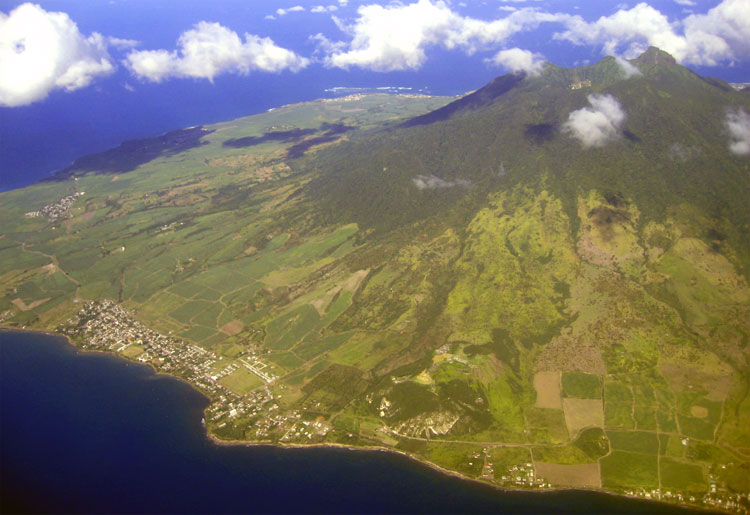
The areas with the highest underground temperatures are in regions with active or geologically young volcanoes. These “hot spots” occur at plate boundaries or at places where the crust is thin enough to let the heat through. The northern island of the Lesser Antilles possesses the potential for geothermal sites. According to Huttrer1999, virtually all the islands are underlain by active or dormant volcanoes. The islands of Saba and Saint Eustatius (Statia) of the Netherlands Antilles, Saint Kitts and Nevis, Montserrat, Dominica, Saint Lucia, Saint Vincent and the Grenadines, and the French territories, Guadeloupe and Martinique form part of the active volcanic arc of the Caribe Oriental and the Lesser Antilles.
From Saba in the north to St. Vincent in the south, active volcanoes and surface hydrothermal manifestations exist on each of the islands. According to Battodetti 1999 Dominica and St. Lucia, exhibit intense surface hydrothermal activity which marks the presence of high enthalpy geothermal systems—230°C at Wotten Waven in Dominica, and 300°C at La Soufrière-Qualibou in St. Lucia.
The geothermal energy potential available in these volcanic islands makes them of interest for exploration. The majority of electricity on these islands is currently being produced by diesel generators and as a result, the costs of electricity are relatively high. The electrical needs of these islands are growing as light industry and tourism growth increase, and the use of an indigenous resource such as geothermal energy would reduce the cost associated with diesel imports.
Table 1: Showing geothermal Energy Potential in the Caribbean

Although geothermal resources are abundant on several of the islands, apart from Guadeloupe which has a 4.5 MWe binary plant, geothermal development is still in the early stages for several reasons. Dominica however, recently signed off on an initiative to construct a geothermal plant that will be funded by the French, European Union and Dominican government at a cost of US $17 million. This project is expected to provide an alternative local energy source, in addition to exporting power to the neighbouring French islands of Guadeloupe and Martinique.
Not only do geothermal resources in the Caribbean offer great potential, they can also provide continuous baseload electricity. According to the U.S. National Renewable Energy Laboratory (NREL), the capacity factors of geothermal plants—a measure of the ratio of the actual electricity generated over time compared to what would be produced if the plant was running nonstop for that period—are comparable with those of coal and nuclear power. With the combination of both the size of the resource and its consistency, geothermal power can play an indispensable role in a cleaner, and more sustainable energy future.
-
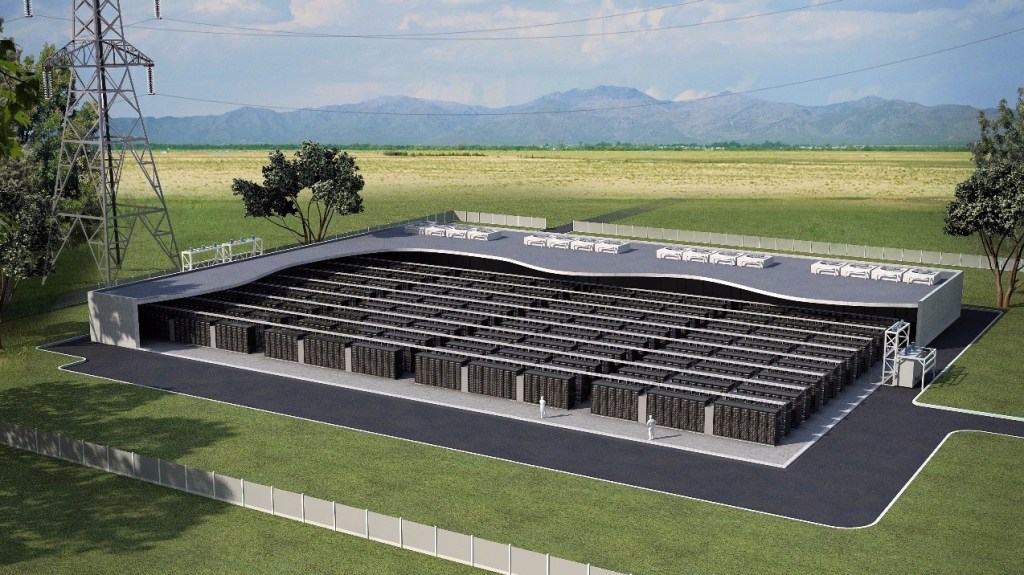
Grid Level Energy Storage
Have you been wondering, like many, what is Grid Energy Storage and why is there so much talk about large-scale energy storage? Well, grid-level energy storage systems (ESS) are large-scale facilities used to store energy in one form or the other (electrical, chemical, potential, gravitational, etc) within an electric power grid.
Energy is stored during times when production exceeds consumption and the stored energy is used at times when consumption exceeds production. In this way, electricity production need not be drastically ramped up and down to meet momentary consumption – instead, production is maintained at a more constant level. This has the advantage that fuel-based power plants (i.e. coal, oil, gas) can be more efficiently and easily operated at constant production levels.
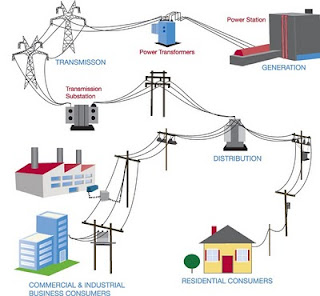
Modern electric grid
In particular, the use of grid-connected intermittent energy sources such as solar (photovoltaic) and wind can benefit from grid-level energy storage. These energy sources are by nature unpredictable – meaning that the amount of electrical energy they produce varies over time and depends heavily on random factors such as the weather. In an electric power grid without energy storage, energy sources that rely on the energy stored within fuels (coal, oil, gas) must be ramped up and down to match the rise and fall of energy production from intermittent energy sources. Thus, grid energy storage is one method that the operator of an electric power grid can use to optimize energy production from intermittent renewable energy resources.
 Grid Energy Storage Application
There are several methods that are currently being pursued as a possible means of grid energy storage. Currently, the list includes:
- Pumped Hydroelectric Energy Storage
- Compressed Air Energy Storage
- Batteries
- Hydrogen
- Super Capacitor
- Flywheel
-

Geothermal Energy
Geothermal energy is heat energy originating from Earth. The word itself was derived from the words geo and thermal meaning Earth and heat respectively. This heat from the earth is used in many ways, including as a source (more…)
-

Jamaica’s Hydroelectric Potential
Jamaica, the paradise island that is sometimes referred to as “the land of wood and water,” has great hydroelectric potential due primarily to its many rivers, land topography and climate. Out of a list of 120 rivers, the Island has several rivers that are suitable for hydroelectric power generation.
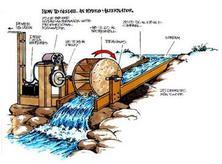
run-of-river hydroelectric plan Hydroelectric power is power generated from water. A basic hydroelectric power plant generates electricity in a three-stage process: First, water wheels are used to capture the kinetic energy (energy of motion) from falling or running water. Next, this kinetic energy is converted into mechanical energy by a gear mechanism attached to the water wheel. Then finally, the mechanical energy is converted into electrical energy by an alternator that is connected to the gear mechanism.
For over 100 years Jamaica has been exploiting its hydroelectric potential through the use of “run-of-river” hydroelectric power plants. There are currently eight (8) such plants in operation across the island today:
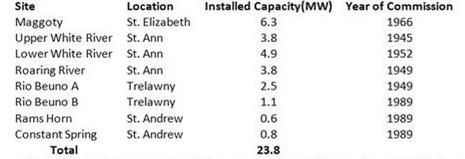
These plants are owned and maintained by Jamaica Public Service Company (JPSCo.). Together they produce approximately 5% baseload capacity for the public electricity grid during the rainy seasons. Most of these systems are fairly old, however, with the youngest ones being more than 15 years old. These eight hydroelectric power stations save the country roughly US$27M on fuel imports annually. The following chart shows historical data of hydroelectric power generation in Jamaica:

In April 2011, the JPSCo unveiled plans to undertake the first major hydroelectric development in Jamaica in 30 years. This involves the commissioning of a new plant that will further reduce the country’s oil import by 48,000 barrels of fuel per year. At an estimated price of $100 per barrel, this would save Jamaica US$4.8M annually. The new plant, which will see the doubling of the capacity at the Magotty Hydroelectric Plant, is scheduled for completion by July 2013.
The Petroleum Corporation of Jamaica (PCJ) has shown through studies that Jamaica’s hydroelectric potential could be further exploited through the construction of a number of small-scale plants. The total technical potential is estimated to be in the range of more than 56 MW, including one large-scale facility at Back Rio Grande, as shown below. While the technical feasibility was proven in most cases, the economic assessment resulted in negative decisions in the past due to the high investment costs involved and comparatively low electricity generation costs from conventional plants. However, with the hike in oil prices (currently at US$99.87 per barrel) resulting in an increase in electricity generation costs, this picture is changing as can be seen from JPS’s recent decision to expand the capacity of the Maggoty Plant.
Currently, the PCJ’s Centre of Excellence for Renewable Energy (CERE) division that has been mandated to support the implementation of new ideas and methods in renewable energy in Jamaica is pursuing several hydroelectric initiatives. The CERE has partnered with two international companies to update the technical, financial and economic feasibility study on five potential hydroelectric projects (listed below). CERE has partnered with BPR’s Power Division in four of the five projects and IT Power Ltd. in the other. BPR is a private engineering consulting firm located in Quebec, Canada, and IT Power Ltd. is a climate change consulting firm located in the United Kingdom.
1. The Back Rio Grande Hydropower Plant: Back Rio Grande is located in the parish of Portland at the north eastern end of the island.
Project Highlights – Back Rio Grande Potentials:
- 6 MW of electricity potential
- 17,120 MWh of electricity per year
- 10,000 barrels of avoided oil imports
- 14,000 tonnes of CO2 emission reductions
- Foreign Direct Investment US$20.7 million
2. The Great River Hydropower plant: Great River borders the parishes of St. James and Hanover, on the north western coast of the island.
Project Highlights – Great River Potentials:
- 8 MW of electricity potential
- 35,218 MWh of electricity per year
- 21,000 barrels of avoided oil imports
- 29,000 tonnes of CO2 emission reductions
- Foreign Direct Investment US$23.6 million
3. The Laughlands Hydropower Plant: Laughlands Great River, a Greenfield site, is located in the parish of St. Ann, on the north coast of the island.
Project Highlights – Laughland Potentials:
- 2 MW of electricity potential
- 13,920 MWh of electricity per year
- 8,000 barrels of avoided oil imports
- 12,000 tonnes of CO2 emission reductions
- Foreign Direct Investment US$6.7 million
4. The Rio Grande (1 & 2) Hydropower Plants: Rio Grande is located in the parish of Portland at the north eastern end of the island.
Project Highlights – Rio Grande Potentials
- 2 MW of electricity potential
- 8,425 MWh of electricity per year
- 5,000 barrels of avoided oil imports
- 7,000 tonnes of CO2 emission reductions
- Foreign Direct Investment US$6.8 million
5. The Swift River Hydropower Plant: Swift River is a tributary of the Rio Grande, located in the parish of Portland at the north eastern end of the island.
Project Highlights – Swift River Potentials
- 2 MW of electricity potential
- 8,390 MWh of electricity per year
- 4,900 barrels of avoided oil imports
- 6,900 tonnes of CO2 emission reductions
- Foreign Direct Investment US$6.5 million
These feasibility studies now open up the door for members of the private sector to step in and play a bigger role in leading the way forward towards the uses of cleaner, and cheaper sources of electricity. Private investors should, however, be aware that current legislation requires a license for all types of water uses, issued by the Water Resources Authority. The license is granted for a period of 5 years but can be extended thereafter. In competing situations, preference is given to fresh-water use over any energetic purposes. All environmental aspects have to be approved by the National Environment Protection Agency (NEPA).
 xenogyre.com